


Don't miss a thing!
Keep up-to-date on all the nesting news.

Video Highlights




News
-
October 15, 2025 Male Condor Knocks Mate Off Cliff During Courtship Display
-
October 7, 2025 New Cam: Watch A California Condor Chick Explore Its Nest
-
April 10, 2024 Most Watched Nest Cam Highlights From Bird Cams!
-
November 20, 2022 California Condor Cam Timeline


About the Nest
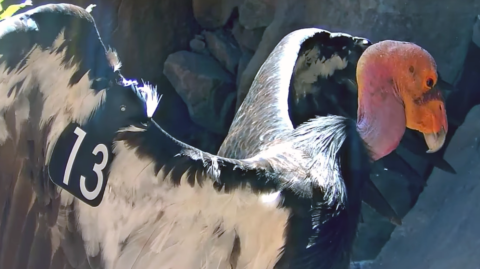
This year’s California Condor Cam experience focuses on not only a new nest, but a new wildlife refuge. This year’s nest is in Orchard Draw located on the Bitter Creek National Wildlife Refuge, featuring #328 (male), #216 (female), and #1379 (chick).
#328 was wild hatched in 2004 in a territory east of the Hopper Mountain National Wildlife Refuge but was evacuated due to injury and then rehabilitated and fledged at the Los Angeles Zoo. He was released at the Bitter Creek National Wildlife Refuge three years later at the end of 2007, taking up a territory with long-term mate, #216, just south of the Refuge in 2011.
Female #216 hatched at the San Diego Zoo Wildlife Alliance in April of 2000 and was one of the earliest condors released back to the wild. She was released at the Hopper Mountain National Wildlife Refuge in 2001 but moved north to Bitter Creek National Wildlife Refuge when she established a nesting territory with long-term mate, #328.
#328 and #216 have nested together since 2011. Their first three nesting attempts were unfortunately unsuccessful, but after moving to their current nest at Orchard Draw, they have successfully fledged chicks every other year since 2017. The two are a common sight at Bitter Creek National Wildlife Refuge and are often seen together at key spots on the Refuge.
Other interesting facts:
- #328 is the offspring of #21 (aka AC-9); #21 was the last condor trapped in the 80s when all wild California condors were brought into captivity in an effort to prevent extinction of the species.
- #216’s first nesting attempt was in 2005 with male #98 in an area very near #328’s natal territory. This nest was unsuccessful, and she did not attempt another nesting attempt with #98 again.
- #1379’s egg was laid on March 10, 2025, and hatched on May 6, 2025. #1379’s full biological sibling, #1245’s egg was laid on April 10, 2023, and hatched on June 6, 2023.

About the Condor Recovery Project
California Condors are critically endangered; they are on the 2014 State of the Birds Watch List, which lists species most in danger of extinction without significant conservation action. They are also listed as Endangered by the U.S. Fish and Wildlife Service and as Critically Endangered by the IUCN. All of the more than 550 condors now alive are descended from 27 birds that were brought into captivity in the early 1980s, in a controversial but successful captive breeding program.
As of 2024, there were more than 350 individuals in the wild in California, Arizona, and Baja California. The number has been rising steadily each year, as captive-bred birds are released and wild pairs fledge young from their own nests. Roughly 200 additional condors live in captivity at breeding programs or on exhibit at the Los Angeles Zoo, Oregon Zoo, World Center for Birds of Prey, Phoenix Zoo, Chapultepec Zoo, San Diego Zoo Safari Park, and San Diego Zoo. Condors have benefited greatly from the Endangered Species Act and from aggressive efforts to breed them in captivity and re-release them into the wild, but the survival of the species is still dependent on human intervention.
The California Condor Recovery Program (Recovery Program) is a multi-entity effort, led by the U.S. Fish and Wildlife Service, to recover the endangered California Condor. Partners in condor recovery include the U.S. Forest Service, National Park Service, Bureau of Land Management, Arizona Game and Fish Department, California Department of Fish and Wildlife, Utah Department of Fish and Wildlife, the federal government of Mexico, Los Angeles Zoo, Oregon Zoo, Santa Barbara Zoo, Chapultepec Zoo, San Diego Zoo, Oakland Zoo, The Peregrine Fund, Ventana Wildlife Society, Western Foundation of Vertebrate Zoology, Yurok Tribe, and a host of other governmental and nongovernmental organizations.
The Recovery Program is now in the final phase of recovery, focusing on the creation of self-sustaining populations. The Program is placing increased emphasis on the captive-breeding and reintroduction of California Condors to the wild and the management of that wild population. These efforts combine trying to reduce the threat of lead with actively managing nesting in the wild to increase the number of wild-fledged chicks.
The goal of the California Condor Recovery Plan is to establish two geographically distinct self-sustaining populations, each with 150 birds in the wild and at least 15 breeding pairs, with a third population of condors retained in captivity. As the Recovery Program works toward this goal, the number of release sites has grown. There are four active release sites in California, one in Arizona, and one in Baja California, Mexico.
Acknowledgements
The effort to create a livestreaming cam on a wild condor nest could not have happened without the effort, funding, and expertise of a wide consortium of collaborators.
About Cams
The Cornell Lab Bird Cams connects viewers worldwide to the diverse and intimate world of birds. We work to make watching an active experience, sparking awareness and inspiration that can lead to conservation, education, and engagement with birds.
Our viewers tell us that watching the cams is a life changing experience: an unprecedented learning experience that they liken to virtual field trips or field biology in their living room. We’re excited to continue sharing and learning with the community as we watch the world of birds together.

Bird Cams is a free resource
providing a virtual window into the natural world
of birds and funded by donors like you
Pileated Woodpecker by Lin McGrew / Macaulay Library