
• Skip to Content
  • Skip to Main Navigation
  • Skip to Local Navigation
  • Skip to Search
  • Skip to Sitemap
  • Skip to Footer
We won a Webby Award!

Bald Eagle

Haliaeetus leucocephalus ORDER: FALCONIFORMES FAMILY: ACCIPITRIDAE

IUCN Conservation Status: Least Concern

  • Similar Species
  • Related Species
  • Go to:
Bald Eagle Photo

The national emblem of the United States, the Bald Eagle was threatened with extinction in the lower 48 states because of DDT (a type of pesticide) poisoning. Protection under the Endangered Species Act, together with reintroduction programs, brought populations up, and the species was reclassified as Threatened in 1995. By 1999 some were suggesting that Bald Eagles could be removed from the endangered species list, and they were delisted in June 2007—a true conservation success story.

Come Join NestWatch

Appearance

Hawks
Hawks
Typical Voice

Adult Description

  • Very large raptor.
  • Adults unmistakable with brown body and white head and tail.
  • Bill large and hooked.
  • Long broad wings held flat while soaring.

Immature Description

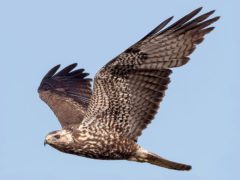
Immature variably patterned with dark brown and white; takes five years to acquire full adult plumage. White not restricted to well defined areas, but appearing scattered throughout body, usually with brown mottling in same area. White in wings primarily in linings and not flight feathers. Bill and cere blackish gray. Eyes dark brown. Feet and lower legs yellow.

Range Map Help

Bald Eagle Range Map
View dynamic map of eBird sightings

Field MarksHelp

  • Adult
    Adult
    • © William L. Newton / CLO, Cape Coral, Florida
  • Adult
    Adult
    • Flying
    • © William L. Newton / CLO, Yellowstone National Park, Wyoming
  • Juvenile
    Juvenile
    • © Robert E. Peltz/CLO
  • Immatures
    Immatures
    • © William L. Newton / CLO, Cape Coral, Florida
  • First year
    First year
    • Flying
    • © William L. Newton / CLO, Cape Coral, Florida

Similar Species

  • Golden Eagle has feathered legs, white limited to flight feathers, and soars with the outer part of the wings lifted in a slight dihedral.