
Download Migration FAQs
Aquila chrysaetos ORDER: ACCIPITRIFORMES FAMILY: ACCIPITRIDAE
IUCN Conservation Status: Least Concern
© Ganesh Jayaraman
The Golden Eagle is one of the largest, fastest, nimblest raptors in North America. Lustrous gold feathers gleam on the back of its head and neck; a powerful beak and talons advertise its hunting prowess. You're most likely to see this eagle in western North America, soaring on steady wings or diving in pursuit of the jackrabbits and other small mammals that are its main prey. Sometimes seen attacking large mammals, or fighting off coyotes or bears in defense of its prey and young, the Golden Eagle has long inspired both reverence and fear.
Golden Eagles are one of the largest birds in North America. The wings are broad like a Red-tailed Hawk's, but longer. At distance, the head is relatively small and the tail is long, projecting farther behind than the head sticks out in front.
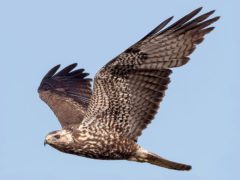
Adult Golden Eagles are dark brown with a golden sheen on the back of the head and neck. For their first several years of life, young birds have neatly defined white patches at the base of the tail and in the wings.
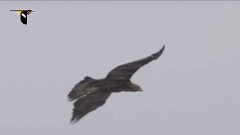
Usually found alone or in pairs, Golden Eagles typically soar or glide with wings lifted into a slight “V” and the wingtip feathers spread like fingers. They capture prey on or near the ground, locating it by soaring, flying low over the ground, or hunting from a perch.
Golden Eagles favor partially or completely open country, especially around mountains, hills, and cliffs. They use a variety of habitats ranging from arctic to desert, including tundra, shrublands, grasslands, coniferous forests, farmland, and areas along rivers and streams. Found mostly in the western half of the U.S., they are rare in eastern states.
Turkey Vultures have much smaller heads and hold their wings in a more pronounced V-shape than Golden Eagles. Their narrower wings are not as steady and they often teeter as they soar. Turkey Vultures have more contrast between their black underwing coverts and the silvery gray flight feathers that form the trailing edge of the wing. Bald Eagles are more common, widespread, and gregarious than Golden Eagles in North America. Bald Eagles have larger heads and soar with their wings flat across, like a board. Adult Golden Eagles lack both the white mottling of immature Bald Eagles and the white head and tail of adult Bald Eagles. Young Golden Eagles often have white patches under the wing and at the base of the tail—but it's always more clearly defined than the white mottling on the body and wings of immature Bald Eagles. Soaring Red-tailed Hawks have shorter wings and smaller heads than Golden Eagles and are typically pale underneath. Seen from below, dark-morph Ferruginous Hawks are paler under the wing and tail than Golden Eagles. When perched, they have rusty tones in the breast and wing coverts and lack the eagle's golden nape.
Get the Lead Out: Ingesting lead bullet fragments has a devastating effect on wildlife—and humans. Story and photos in Living Bird magazine.
Golden Eagles and Us: Story and photos in Living Bird magazine.