
Similar Species
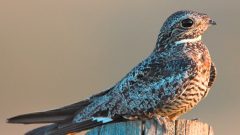
Lesser Nighthawks of the southwestern U.S. are easiest to distinguish from Common Nighthawks by the white bar on the wings. In Lesser Nighthawks this mark is closer to the tip of the wing, leaving a dark equilateral triangle for the wingtip rather than the longer, isosceles triangle created by the white bar of a Common Nighthawk. Lesser Nighthawks are also typically buffier, with somewhat more rounded wings than Common Nighthawks. Antillean Nighthawks are sometimes seen in southern Florida. They are very similar to Common Nighthawks but usually have buffy undertail coverts that contrast with a grayish belly. Their kitty ki-dick calls are much more useful than plumage for identification since the calls are so different from the peent calls of Common Nighthawks. Whip-poor-wills and Chuck-will’s-widows are less active at dusk and more active at night than nighthawks. They tend to forage with fairly short, low flights compared to the wide-ranging, looping flights of Common Nighthawks. Whip-poor-wills and Chuck-will’s-widows do not have white marks in the wings or on the throat. In silhouette, Common Nighthawks have a similar shape to American Kestrels, but with a bigger head and a slightly notched tail. They also fly differently, with an erratic, looping flight, and they have conspicuous white bands in the wing that kestrels lack.
Regional Differences
Eastern birds are browner than those from the northern Great Plains, which are silvery gray overall.
Find This Bird
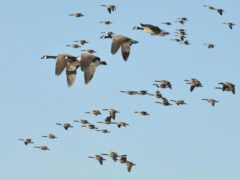
Common Nighthawks are easiest to see in flight at dawn and dusk as they forage for aerial insects. Pick a high overlook with a good view of a river, if possible. In towns, look for nighthawks over brightly lit areas such as billboards, stadium lights, and streetlights. Scan the darkening sky and you’ll likely find some bats zipping around with their frenzied flapping—but look for a larger, bounding, long-winged shape. If you don’t see one, listen for low, buzzy peent calls. If you are in an area with breeding nighthawks, pay attention for the bizarre booming noise of a territorial or courtship flight.