
Ask an Expert
Send us your bird question using the form below. Each week, we'll select a question to answer as our Question of the Week. We apologize that because of the high volume of questions we receive, we are unable to reply personally to them all.
You may also find answers by joining the discussion at WeLoveBirds.org, a free online community of bird enthusiasts founded by the Cornell Lab and Natural Resources Defense Council.
Frequently Asked Questions
Tip: To search for text on this page, type Control-F (Command-F on a Mac) and type your text into the search box that appears (at the bottom left of the window in most Internet browsers).
1. Baby Birds
Q. How long do birds usually incubate their eggs? And, once hatched, how long does it usually take for young birds to fledge from the nest?
Q. My son brought home a baby Killdeer. It was so adorable that we all fell in love with it. He put it in a box with a lot of worms and birdseed, but it wasn't the least bit hungry—it didn't eat anything at all. It was still fun and active, so we figured it would eat when it got hungry, but a couple of mornings later he found it dead. What happened?
Q. I found a baby bird on the ground. What should I do? I don't want it to die.
Q. If I don't pick up a baby bird, will my cat or dog kill it?
Q. I want to give my children the opportunity to raise a baby bird, but my friends told me not to. I know that a lot of ornithologists got their start by raising crows and other birds. What do you think?
Q. If I handle a baby bird, won't its parents pick up my scent and abandon it?
Q. My dog once killed a baby robin, so last year when robins nested in my yard, I took the eggs to a rehabber, but she refused to take them. Why?
Q. Why do birds leave the nest before they can fly?
Q. We have baby ducks in our fountain at work that are being picked off by crows. Is there any way to save them?
Q. We're watching some Canada Geese at work and starting to wonder if these babies will recognize their parents after they're grown up?
Q. While trying to take a picture of a mother Blue Jay sitting on her eggs, I unintentionally spooked her. She flew away and has not returned to her nest. Will she ever return & what if she doesn't what will happen to her eggs? Should I bring them in & try to hatch them myself?
2. Sick and Injured Birds
Q. What do I do if I find a sick bird?
Q. What should I do if I find a dead bird?
Q. I've been seeing a few House Finches with red, swollen, and weepy eyes. What's wrong with them?
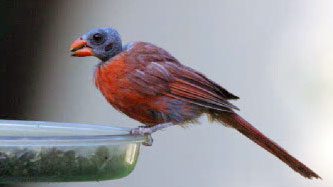
Q. I have a bald bird at my feeder. Is it sick?
Q. A bird keeps flying into my window, on purpose! Why is it doing this? I'm afraid it will hurt itself. What should I do?
Q. During migration, I keep finding dead birds under my picture window. What should I do?
Q. I was cleaning out my next boxes and I found a dead adult Tree Swallow in one of them. How did it die?
Q. I have wasps in my birdhouse. What should I do?
Q. I read that Brown Pelicans frequently die of blindness because they develop cataracts as a result of their diving behavior. I find this to be preposterous and wonder if you have any light to shed on this subject.
Q. I've seen a bird with an overgrown or otherwise deformed bill. What is wrong with it?
Q. How can I keep birds from hitting my windows? Hawk decals don't seem to work.
3. Bird Feeding
Q. Is it okay to keep feeding birds in the spring and summer?
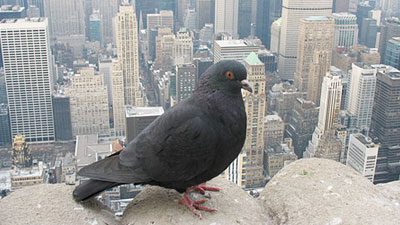
Q. My feeders are being overrun with pigeons and blackbirds who eat all the food and keep the nicer, smaller birds away. What can I do?
Q. I read that I should always make my hummingbird nectar with one quarter cup of sugar for every cup of water, but one of my friends, who gets more hummers than I do, uses more sugar. What's the truth?
Q. All the hummingbird food mixtures I see in stores are red, but my neighbor said food coloring is dangerous. Is that true?
Q. Every summer most of my hummingbirds disappear for a few weeks, and then suddenly reappear in large numbers. What's going on?
Q. The hummingbirds at my feeder are fighting way too much! My feeder has eight ports—why can't they share?
Q. I have been told that I should stop feeding hummingbirds in the fall so that they can begin their southern migration. Is this correct?
Q. We have a hawk that comes to our yard on a regular basis, and yesterday he killed a Mourning Dove. How can I get rid of him and keep the songbirds and doves?
Q. What should I do if I find algae in my birdbath?
Q. There aren't any birds at my feeders. I'm used to having lots of them. What's going on?
Q. Do birds come to feeders because they see the seed or can they smell it?
Q. I live in a high-rise apartment with a tiny balcony. Is there any way I can attract birds all the way up on the 17th floor?
Q. Is there a simple way to get rid of or eradicate starlings? My back yard has many feeders for jays, sparrows, finches, and even hummers. They also get to enjoy several fountains and bird baths. The starlings who have started nesting in the eaves of my garage/shop are now invading my yard, totally unwanted! How can I get rid of them?
Q. We have 50-75 birds of several species at our bird feeders here in Michigan. Our feeders include suet and seed and must be refilled daily. Do birds store food for the winter?
Q. I live in Southern California and recently have noticed small compacted bundles of what appears to be fur and small bones scattered under a large pine tree in my yard. Someone said it is from owls regurgitating what they can't digest. Is this true?
Q. I recently moved to the top (28th) floor in a high-rise condo building close to the lakefront in Chicago. I was an active bird watcher and had many feeders in my backyard in the suburbs. Do you have any suggestions for feeding/feeders or will I be wasting my time? I have a 13 x 17 foot terrace with glass doors. I would like to put out a feeder. —Michael
4. Bird Identification
Q. Now that spring is here, I'm going to start bird watching. What's the best bird identification book out there?
Q. Oh, my gosh! I just saw the coolest bird at my feeder. It's mostly black and white but it has a bright red triangle on its breast. What is it?
Q. Yesterday evening around dusk I watched hundreds and hundreds of birds flying over my house. What were they?
Q. There's a bird in my yard I've never seen before. How can I find out what it is?
Q. This is the first year I've had a bird feeder, and all summer my goldfinches have been so beautiful! But suddenly they're looking really weird, with ugly dull patches around their bodies the way my children had spots when they had chicken pox. Are these birds sick? Is the food they're getting at my feeder missing something important?
Q. Every House Finch I've ever seen at my feeder has been a pretty shade of red until this year, when two weird ones showed up. One is orange, and the other is yellow! What's wrong with them?
Q. There's a strange partly white bird in my yard. It looks like a junco (or other species) except for some completely white feathers on its head and wing. What is it?
Q. I've heard that birds sometimes show weird color variations that make them look completely different. As a beginner, how can I figure all this out?
Q. I live in Wisconsin. One of my friends reported a Varied Thrush at our bird club meeting and the next day everyone rushed out to see it. I looked in my field guide, and those are western birds that do not belong in Wisconsin. The next month I was pretty sure I spotted a McKay's Bunting, but when I reported it at the meeting, no one believed me! Is that fair?
Q. Why are some species found out of their normal range more than others?
Q. I saw a rare bird. Am I supposed to tell anyone? Will they believe me?
Q. There are so many field guides to choose from! How do I pick one?
Q. There's a flock of 25 birds that look like female cardinals in my tree. What could they be?
Q. I’m interested in doing more than just looking at my backyard birds, but isn’t birding an expensive hobby, with state-of-the-art equipment and a lot of travel?
Q. My husband bought me a really great pair of binoculars, but whenever I try to look through them, everything sort of blacks out and I can’t see a thing. How can I adjust them?
Q. I've just upgraded my optics. What should I do with my old binoculars?
5. Migration
Q.How do hurricanes affect migrating birds, and is there anything we can do to help the birds that have been negatively affected?
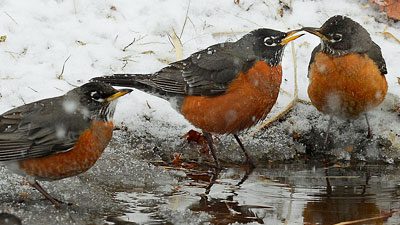
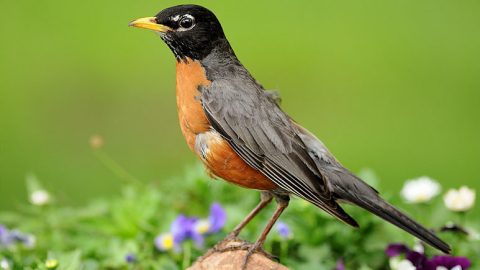
Q. What happened to all the robins? I'm not seeing them any more.
Q. I have a hunch that the bird singing outside my window is the same one who nested here last year. Could that be true?
Q. How do birds prepare for long migrations?
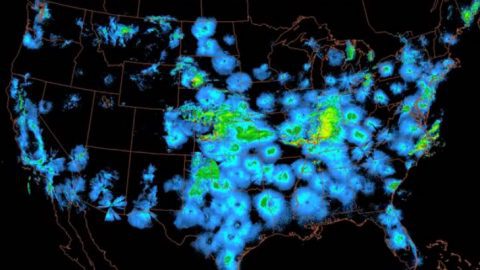
Q. I've heard you can tell if birds are migrating on a particular day by looking at a weather map! How does that work?
Q. Is it possible I've heard a whole flock of swans migrating overhead late at night?
6. Birds vs. People
Q. I discovered a bird nesting in a shrub next to our house. We're planning on having the house painted next week. What should I do? Can I move the nest?
Q. A bird built its nest in my boat. I'm going to need that boat in a few weeks. I don't want to hurt the bird or any babies, but how long before I can use my boat again?
Q. I have a small, five-pound dog that likes to run around our backyard. Should I be worried that a hawk or owl could pick him up and take him away?
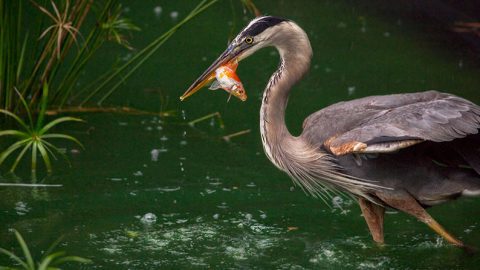
Q. I have a pond behind my house that I've stocked with fish. Several herons have been taking fish from the pond. I don't want to harm the birds, but I do want to stop them from taking these fish. Do you have any suggestions?
Q. There's a huge starling roost near my house and they're driving us nuts! What can we do?
Q. Why do woodpeckers like to hammer on our homes?
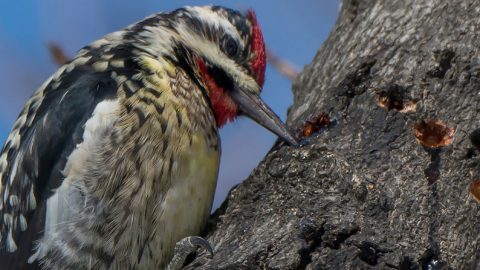
Q. A Yellow-bellied Sapsucker is destroying my beautiful tree! What can I do?
Q. A bird is singing all night long outside. Short of changing the front yard landscape, what do I need to do to quiet this bird? I lay awake almost every night listening to this bird just outside my window. Eventually, I get up and shake the tree until the bird takes flight. Is there an easier way to "get rid" of it—at least until sunrise?
Q. Are turkeys bred and eaten in Europe?
Q. Can you give me a list of the birds most frequently seen, or known to reside, in the Gulf of Mexico? I cannot seem to find a list anywhere on the Internet. If the list is too extensive, could you tell me which birds in the Gulf area are endangered or threatened (especially by the BP oil spill)?
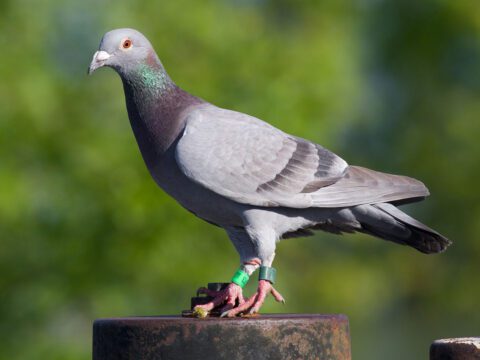
Q. This afternoon I opened my door and a beautiful white and gray dove walked into my garage. It went to an empty hutch so I gave it fresh water and food. It was very tame. One leg has a plain green band and the other leg has a red band with numbers on it. What should I do?
7. Bird Sounds
Q. Why do some birds mimic the sounds of other species?
Q. Which birds are the best mimics?
Q. Do parent and baby birds recognize each other's songs or calls?
Q. Do bird songs have frequencies higher than humans can hear?
Q. What is the most beautiful bird song in North America?
Q. Why are Blue Jays far more noisy in fall than earlier in the summer?
Q. Are starlings known for their mimicry? We live in South Philadelphia, in a row home, so I have been a witness to several unusual mimicries by the starlings. They imitate cats, and my boyfriend's motorcycle alarm. I was wondering if this is normal behavior for a starling? The cat call in particular is so realistic that I spent 10 minutes looking for the "cat" before I realized that it was a bird.
Q. I live in the woods in northern Minnesota, and in May and June I usually wake up to a Winter Wren singing near my cabin. How does such a tiny bird produce so many sounds so quickly?
8. Birds and Science
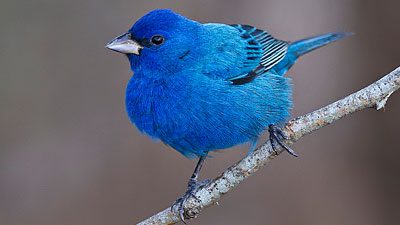
Q. What makes Indigo Buntings look new?
Q. We have an Aunt that insists the only name is "Canada Goose." We believe we can also say "Canadian Goose." Are we wrong?
Q. Do birds sleep—and how?
Q. Why can't penguins fly?
Q. Do vultures find dead animals by smell or by tracking predators or scavengers on the ground?
Q. Who is the "Lincoln" that the Lincoln's Sparrow is named for? I have looked in the Birders' Handbook for that info with no luck.
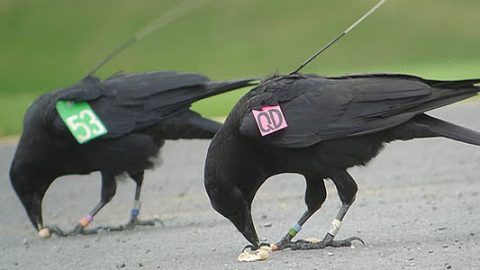
Q. On a visiting to Ithaca I saw a crow with large, red tags on each shoulder. Is this one of your projects?
Q. I believe that the same blue heron has been perching on my dock for 28 years. What is their life span?
Q. How much do birds eat each day?
Q. How do you pronounce a scientific name? What's the proper pronunciation for this bird species, Tympanuchus phasianellus?
Q. How can Bald Eagles survive in northern areas after all the lakes have frozen?
Q. Why don't birds get cold feet?
Q. Do birds play?
Q. Please could you tell me if pelicans have teeth?
9. Bird Breeding and Nests
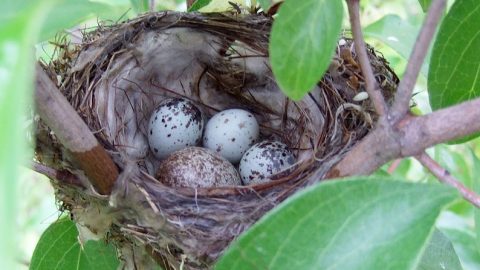
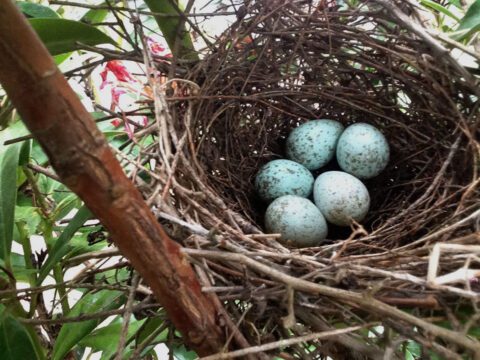
Q. There is a larger egg with speckles in a nest with four other smaller white eggs. What birds in N New Jersey tend to 'borrow' others' nests for their eggs?
Q. Is there any way for me to protect my Sparrow's bird house from an aggressive Blue Jay? I'm convinced that the Blue Jay killed one of the baby birds because it came back two times—right in front of me, bold as you please—to get the remaining hatchling out of the bird house. There's bird seed all over the place but the Blue Jay seems determined to get the baby bird.
Q. Why do birds have such elaborate and varied courtship rituals?
Baby Birds
Q. How long do birds usually incubate their eggs? And, once hatched, how long does it usually take for young birds to fledge from the nest?
A. The time for incubation varies widely from species to species. You can get this information for any species you're interested in by going to its page in our Bird Guide. Start here.
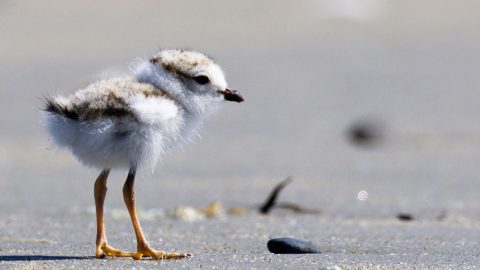
Q. My son brought home a baby Killdeer. It was so adorable that we all fell in love with it. He put it in a box with a lot of worms and birdseed, but it wasn't the least bit hungry—it didn't eat anything at all. It was still fun and active, so we figured it would eat when it got hungry, but a couple of mornings later he found it dead. What happened?
A. Baby Killdeer, like baby ducks, geese, and poultry, are what we call "precocial chicks." These chicks hatch out covered with thick down, open their eyes quickly, and are perfectly capable of walking. Within minutes of hatching, they imprint on their parents and follow them tenaciously. Both parents show them food items, which they pick up and eat. The family unit stays together for several weeks.
Killdeer chicks grow rapidly, requiring huge amounts of food, but the chick your son found had already imprinted on its parents and needed to be with them in order to recognize food and to eat.
If this ever happens again, the best thing to do is to bring the chick back and search for the adults. If you get anywhere near the rest family, one of the parents may give a broken-wing display, acting as if it's injured. You should set the chick down and leave as quickly as possible. It's sad to leave these adorable balls of fluff, but it's much sadder, for the bird as well as for children, when it starves to death.
If you don't know where a Killdeer chick was picked up, but do know where another Killdeer family is, with chicks close in size to the one you're dealing with, release it with that family. This also works in the case of ducklings and goslings.
For more information about helping baby ducks, geese, Killdeer, and other precocial chicks, try the Wildlife Rehabilitation Information Directory.
Q. I found a baby bird on the ground. What should I do? I don't want it to die.
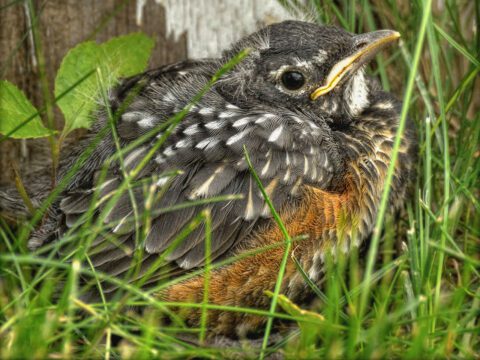
A. At some point, nearly everyone who spends time outdoors finds a baby bird—one that is unable to fly well and seems lost or abandoned. Our first impulse is to adopt the helpless creature, but this often does more harm than good—and in most cases, the young bird doesn't need our help at all.
The first thing to do is to figure out if it's a nestling or a fledgling. If it's sparsely feathered and not capable of hopping, walking, flitting, or gripping tightly to your finger, it's a nestling. If so, the nest is almost certainly nearby. If you can find the nest (it may be well hidden), put the bird back as quickly as possible. Don't worry—parent birds do not recognize their young by smell!
If the bird is feathered and capable of hopping or flitting, and its toes can tightly grip your finger or a twig, it's a fledgling. Fledglings are generally adorable, fluffy, with a tiny stub of a tail. It's easy to jump to the conclusion that the bird has been abandoned and needs you. But fledglings need a special diet, and they need to learn about behavior and vocalizations from their parents—things we can't provide.
Fortunately, the vast majority of "abandoned" baby birds are perfectly healthy fledglings. Their parents are nearby and watching out for them. The parents may be attending to four or five young scattered in different directions, but they will most likely return to care for the one you have found shortly after you leave.
When fledglings leave their nest they rarely return, so even if you see the nest it's not a good idea to put the bird back in—it will hop right back out. Usually there is no reason to intervene at all beyond putting the bird on a nearby perch out of harm's way. Fledglings produce sounds that their parents recognize, and one of them will return and care for it after you leave.
If you have found both parents dead or are otherwise absolutely certain that the bird was orphaned, then your best course of action is to bring it to a wildlife rehabilitator. The National Zoo has excellent information on emergency care until you can get an injured or truly abandoned bird to a wildlife rehabilitator.
Q. If I don't pick up a baby bird, will my cat or dog kill it?
A. It might if it gets the chance. The best thing to do is to keep your pet inside, or leashed well away from the fledgling until the bird is gone. This helpless stage lasts at most a few days, and if you leave the young bird under the care of its parents, it will have a far greater chance of thriving over a lifetime.
Q. I want to give my children the opportunity to raise a baby bird, but my friends told me not to. I know that a lot of ornithologists got their start by raising crows and other birds. What do you think?
A. We strongly advise you not to, for two reasons. First, it violates federal and state laws, such as the Migratory Bird Act, to possess any wild native American bird for any length of time without proper permits. Second, even with expert care and feeding, people simply cannot provide baby birds with most of the skills they need to negotiate the natural world.
For excellent, well-reasoned information about the pros and cons of raising baby birds in captivity, visit Dr. Kevin McGowan's webpage, "I Found a Baby Crow." Much of the information about baby American Crows applies to other songbirds as well.
If you want to give your children wonderful experiences with wild birds, encourage them to spend time helping a local rehabber, bird bander, or researcher.
Q. If I handle a baby bird, won't its parents pick up my scent and abandon it?
A. It's a myth that parent birds will abandon young that have been touched by humans—most birds have a poor sense of smell, and birds in general identify their young using the same cues we humans do—appearance and sound. It's perfectly safe to pick up a fallen nestling and put it back in the nest, or to carry a fledgling out of danger and place it in a tree or shrub.
Q. My dog once killed a baby robin, so last year when robins nested in my yard, I took the eggs to a rehabber, but she refused to take them. Why?
A. Rehabbers virtually never incubate eggs. If they've fallen from the nest or been handled by people, the chances are just too great that the growing embryo has been shaken. If the egg eventually hatches, the hatchling is likely to suffer from grave deformities. If you're concerned about your dog harming baby birds, the best thing to do is to keep your pet inside, or confined by a leash, during the few days or weeks until the young birds fly away.
Q. Why do birds leave the nest before they can fly?
A. It's to some young birds' advantage to leave the nest as soon as they can. People tend to think of nests as safe, cozy little homes. But predators have a pretty easy time finding a nest full of loud baby birds, and nests can be hotbeds of parasites. So parent birds work from sunrise to sunset every day to get their young grown and out of the nest as quickly as possible. After fledging, the young birds are more spread out, and the parents can lead them to different spots every night, enhancing each one's chances of survival. Some species, such as swallows, woodpeckers, and other cavity nesters, nest where there are no nearby branches for young to awkwardly grab onto when they first leave the nest. Unless startled by a predator, young of these species tend to remain in the nest until they are strong fliers.
Q. We have baby ducks in our fountain at work that are being picked off by crows. Is there any way to save them?
A. What a heartbreaking situation! Besides crows, baby ducks are frequently taken by large predatory fish and turtles (not normally found in fountains!), dogs and cats, skunks, raccoons, foxes, coyotes, hawks and owls—there are so very many things that kill them that duckling broods are very large yet overall their numbers don't increase from year to year.
Crows aren't big enough to take large ducklings—after they made it to two or three weeks old, they'd be safe from them. But I can't think of a good way to protect the small ducklings from above, where the crows drop in on them, short of a huge net or tent.
We at the Cornell Lab of Ornithology were saddened a couple of weeks ago when mink raided all the Canada Goose nests on our pond, destroying every single egg when they were close to hatching. It was heartbreaking after watching the hard work the pairs did for so long.
Predation is natural, but it sure can be hard to watch when those are baby ducklings you have felt connected to. Let us know if any survive.
Q. We're watching some Canada Geese at work and starting to wonder if these babies will recognize their parents after they're grown up?
A. It's interesting that you asked about Canada Geese because yes, they do continue to recognize their parents, and may even rejoin their parents and siblings during winter and on migration. They may be in the minority among bird species, though. Cranes, crows, and jays probably also remember their families throughout their lives, but most birds don't recognize their family members after their first year. Every autumn, Black-capped Chickadee fledglings scatter, and each one joins a different winter flock from its siblings and parents.
Mallards and grouse do imprint on their parents, but there is no evidence that they recognize their parents or family members after their first year.
Q. While trying to take a picture of a mother Blue Jay sitting on her eggs, I unintentionally spooked her. She flew away and has not returned to her nest. Will she ever return & what if she doesn't what will happen to her eggs? Should I bring them in & try to hatch them myself?
A. You should not try to hatch the eggs yourself. It takes an expert to hatch eggs, keeping them at the right temperature and humidity and turning them properly. If any of these are done improperly, and if the young survive to hatch, they are likely to have deformities that can doom them to a very brief and painful life.
It's even trickier to provide proper nutrition to hatchlings, which need to be fed small but increasing amounts of food every 10-15 minutes from sunrise to sunset for about 3 weeks. And young Blue Jays need to learn normal Blue Jay behavior and skills from their parents in order to survive, feed themselves, avoid predators, and communicate with each other. Once baby Blue Jays fledge, they remain with their parents for 3 months or longer while they continue their education. People simply cannot provide all these things. Professional rehabilitators have developed a lot of techniques for dealing with all this, but even so, their birds almost always have a much shorter life expectancy than do birds raised in the wild by their natural parents or by foster parents of their own species.
The good news is that mother birds do typically return to their nest after you've gone away, since they have a lot invested in their eggs. But to learn the safest ways to monitor bird nests to avoid frightening the parents, visit Project NestWatch at www.nestwatch.org
Sick and Injured Birds
Q. What do I do if I find a sick bird?
A. Once in a while people come upon a bird acting lethargic and sick. We're most likely to see sick birds at our feeders. Why? Our feeders provide an up-close and personal look at the birds in your yard, making it easier to detect one acting different from the rest. Also, some sick birds are actually drawn to feeders, needing an easy meal. But people also find sick birds in lawns after spraying, during outbreaks of West Nile Virus, and in other situations.
What should you do if you find one? Don't take it to a rehabber or veterinarian before calling to make sure they can take it. Some clinics simply don't have the facilities to isolate sick birds, and can't take the risk of spreading a communicable disease among their other birds. To protect yourself, your family, and your pets, don't handle any potentially sick bird without disposable gloves, and make sure you have a box prepared for it, and a place to bring it, before you put it through the trauma of capture.
If your area is possibly having an outbreak of West Nile Virus or other disease, you may need to report it to your county health department or department of natural resources. To find out, call your nearest game warden or conservation office.
Prevention is the key to avoiding the spread of disease. Regularly clean your feeders even when there are no signs of disease. A 10% bleach solution is often recommended and some feeders can even be placed in your dishwasher. If a sick bird does come to your feeder, minimize the risk of infecting other birds by cleaning your feeder area thoroughly. If you see several diseased birds, take down all your feeders for at least a week to give the birds a chance to disperse. And make sure to keep your birdbaths clean. Water allowed to sit for more than a few days can provide perfect breeding habitat for the very mosquitoes most likely to spread West Nile Virus.
The Cornell Lab of Ornithology's Project FeederWatch web site has additional information on sick birds, including a review of several of the more common diseases that might show up in backyard birds.
Q. What should I do if I find a dead bird?
A. West Nile Virus and avian flu have raised everyone's awareness and concern when they see a dead bird. Dead birds are sometimes of interest to health officials and scientists.
If you're aware of a disease outbreak or you are concerned about health issues, contact your local or county health department or the National Wildlife Health Center. Proceed in collecting or disposing of the dead bird as they direct you to. In many cases health departments will not be able to analyze a bird that has already started to decay, so you may be asked to double-bag it and put it in your freezer, or to take it to them immediately. If you do pick up the bird be sure to wear disposable gloves, and wash your hands thoroughly afterward.
After any health and safety issues have been resolved, and especially if you know this bird was killed by a cat or in a collision with a window or automobile, or in some other way not associated with disease, you might turn your thoughts to collecting the bird for scientists at a university or museum. Start by contacting a wildlife professional that has a federal and state permit to collect birds or bird parts. (You may find such a person at a nearby university, museum, nature center, as well as some elementary and high schools.)
Remember the bird's location. Do not pick up the bird without permission, because this is illegal. The Migratory Bird Treaty Act of 1918 protects birds and bird parts (feathers, eggs, and nests) of all native American birds by forbidding anyone without a permit to own or handle birds or bird parts. Though at first glance the law may seem overly strict, it serves an important conservation purpose by allowing authorities to curtail activities that harm birds.
If you’re instructed to bring the bird in under the authority of someone else’s permit, remember to record your name and contact information, the date and location, the bird’s species (if known) and a description of the circumstances, including your best guess about the cause of the bird’s death. Use a pencil or permanent ink. If you’re instructed to freeze the bird until you can bring it to the facility, double-bag it in plastic, and put the paper with this information between the two layers.
For more information in donating a bird for scientific study, read the Spring 2000 issue of BirdScope, "So You Found a Dead Bird".
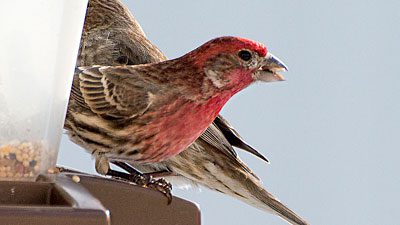
Q. I've been seeing a few House Finches with red, swollen, and weepy eyes. What's wrong with them?
A. House Finches with weird-looking eyes are probably afflicted with mycoplasmal conjunctivitis, also known as House Finch Eye Disease. In early fall, the prevalence of this infection increases dramatically, and sick birds may appear at feeders.
We urge people with feeding stations to join our House Finch Disease Survey. Because we're trying to track where the disease is and how prevalent it is, we also need information about where the disease is not, so we welcome participants even when there is no sign of disease at your feeders. Remember, if the only people who reported had diseased birds, our data would suggest that 100 percent of all feeders were infected!
There is little evidence that feeders play a direct role in disease transmission, because House Finches are highly gregarious and stay close together near or away from feeders. But to be safe, if you notice sick birds, we recommend that you take down your feeders and clean them with a 10 percent bleach solution (1 part bleach and 9 parts water). Let them dry completely and then re-hang them. Also, rake the ground beneath your feeders to remove old seed and bird droppings. If more than one bird gets sick from this or any other illness, it's not a bad idea to close down your feeding station for a couple of weeks to at least encourage the flock to disperse, to minimize the risk of other birds catching it.
To learn more about this disease and the citizen science project that tracks it, please visit the House Finch Disease Survey website.
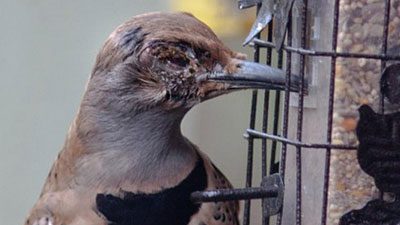
Q. I have a bald bird at my feeder. Is it sick?
A. In fall, we receive many inquiries about bald birds, especially Blue Jays and Northern Cardinals. In late summer and fall, when a bird molts, it usually grows and replaces its feathers gradually, but occasionally a bird loses all the feathers on its head at once. This is particularly true of Blue Jays, many of which molt the feathers of the head, or "capital tract," in synchrony. The result is a very strange looking bald bird! This bald appearance lasts for about a week before new feathers replace the molted ones.
It is possible that in rare cases baldness might be caused by environmental or nutritional factors, feather mites, or lice. To read more and take a look at photos of other bald birds, visit the Bald Birds page on the Project FeederWatch web site.
Q. A bird keeps flying into my window, on purpose! Why is it doing this? I'm afraid it will hurt itself. What should I do?
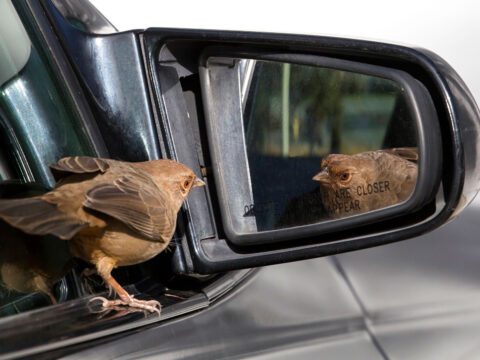
A. The behavior you mention often occurs in spring and early summer. This is the time of year when most birds establish their territories, find a mate, lay eggs, and raise young. To ensure success, they defend their territory aggressively, and will attack and try to drive away any bird they view as a possible competitor or a threat to their young. When they see their own reflection in your window, they assume they're seeing a competitor and attack the image. The species most likely to do this are those that nest close to houses, such as American Robins, Northern Cardinals, bluebirds, California Towhees, Chipping Sparrows, and Song Sparrows. Both males and females engage in this.
Fortunately, this behavior usually dissipates within a few days or, at most, weeks. But while it lasts, the bird may exhaust or even hurt itself, and it distracts the bird from far more important activities. And this behavior can be extremely annoying for the people witnessing it.
To get rid of the reflection, you must alter the outside of the window. You can cover it with netting, fabric, or newspaper, or smear soap streaks on the glass. When you're no longer seeing the bird nearby you can remove this. Often, rubber snakes frighten birds away, at least temporarily—although like any object that doesn't move, the birds get used to seeing them. Helium-filled Mylar balloons on 3–4 foot strings make movements and cast glaring light that birds find confusing and even alarming. Setting a few near a window will frighten away most birds.
We have more information about protecting your birds from windows here.
Q. During migration, I keep finding dead birds under my picture window. What should I do?
A. Windows may be the number one direct killers of birds in America. Researchers estimate that between 100 million and 1 billion birds are killed by colliding with glass every year, in the United States alone!
If you're selecting new windows while building or remodeling, if at all possible choose double-hung windows or other types with the window screens on the outside. If you're putting up a large picture window and like the effect of small panes, putting dividers on the outside as well as the inside will also help.
But most of us are stuck with the windows we already have, or are limited in our options in selecting new windows. Sticking one or two decals on a window will not help. You might try one of these techniques, ranked roughly from most to least effective:
- Cover the glass on the outside with window screening at least 2–3 inches from the glass, taut enough to bounce birds off before they can hit the glass.
- Cover the outside surface of the glass with a one-way transparent film that permits people indoors to see out, but makes the window appear opaque on the outside.
- Place vertical strips of tape on the exterior glass, set no more than 4 inches apart, or cover the exterior glass with decals placed close together (no more than 4 inches apart).
- Mark the glass with permanent paint or markers. Birds can see in the ultraviolet spectrum, but painting windows with ultraviolet markers usually helps for only a few days because most of these inks fade very quickly.
- Install external shutters and keep them closed when you're not actively enjoying the light or view.
- If you have interior vertical blinds, keep the slats half open.
Visit our Window Collisions page for more suggestions and photos of window treatments that help prevent collisions.
Q. I was cleaning out my next boxes and I found a dead adult Tree Swallow in one of them. How did it die?
A. Tree Swallows migrate a long way—some of the birds that nest in northern Canada and Alaska winter down in Central America. If they arrive when the temperature is too cold for flying insects, their primary food, they may die of starvation or hypothermia. This is probably what happened to your swallow, especially if swallows or bluebirds have used your nest box successfully in past years.
There are a few other reasons why adult birds may die in a nest box.
- If it had obvious injuries, especially on its head, it may have been killed by a House Sparrow or European Starling trying to take over the box. In most cases, though, these competitors toss out birds after they kill them.
- Was the inside front of the box, below the hole, rough or grooved? Sometimes birds get stuck inside boxes because the inside walls are so smooth that they can't climb out. Tacking sandpaper or small strips of wood, making sort of a ladder, will prevent this in the future.
- Sometimes an infestation of blowflies or other parasites can become so intense that it kills not only nestlings but also adults. If there was no sign of dead young with the adult, that's probably not the answer in this case.
- Some wood preservatives may release harmful gases, especially in hot weather. Make sure any paints or varnishes that you use on your nest boxes are rated safe for indoor or playground use.
Nestwatch, a citizen-science project of the Cornell Lab of Ornithology, has a wealth of information for people who have nest boxes. For features of a good nest box, check out the page, "Resources for Nest-Box Monitoring." You might also like to join Nestwatch and let us know what is happening in your nest boxes.
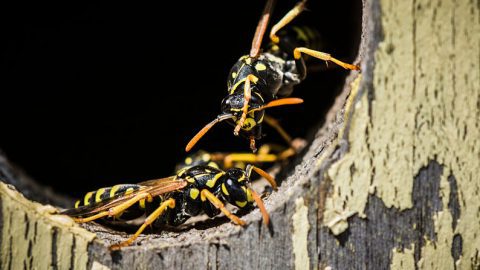
Q. I have wasps in my birdhouse. What should I do?
A. Wasps and bees seldom usurp boxes from nesting birds. They are mostly found in empty boxes. If these insects are found in a box, it is best to let them be and not take any active measures to exterminate them. Instead, wait to clean them out in the fall when the weather is cooler and their activity has halted. You can prevent wasps and bees from establishing themselves by applying a thin layer of soap (use bar soap) onto the inside surface of the roof. This will create a slippery surface between the insects and the roof of the box. For more information about maintaining nest boxes, visit Nestwatch.
Q. I read that Brown Pelicans frequently die of blindness because they develop cataracts as a result of their diving behavior. I find this to be preposterous and wonder if you have any light to shed on this subject.
A. Pelicans have special adaptations to protect their eyes, and the rest of their bodies, from the impact of repeated diving, even though they may plunge into the water from as high as 65 feet. To cushion their internal organs from the impact, just before hitting they inflate air sacs beneath the skin on their breast. While diving, they also rotate their body to the left, probably to avoid injury to their trachea and esophagus, which run along the right side of their neck.
However, pelicans do sometimes lose their vision for other reasons, including infections resulting from disease or hook and line injuries.
These cases are relatively rare, however, compared with other causes of injury and mortality. Wendy Fox, executive director of the Pelican Harbor Seabird Station in Florida, told us that she has seen only several blind pelicans out of some 10,000 pelicans that came through the rescue and rehabilitation center in the past 25 years. Wendy says that about 90 percent of all pelican injuries were caused by hooks from fishing lines.
Another important cause of mortality for Brown Pelicans is starvation. During some weather conditions fish may be scarce, and migrating birds, especially younger ones that haven't perfected their fishing skills, are especially vulnerable.
Q. I've seen a bird with an overgrown or otherwise deformed bill. What is wrong with it?
A. Sometimes birders observe birds with odd-looking beaks. For example, numerous Black-capped Chickadees with greatly elongated and down-curved upper beaks were reported in 1998-1999 in southern Alaska. Scientists studying this phenomenon have yet to determine a specific cause. Bird beaks are much like human fingernails—soft structures that grow at a constant rate all the time. Many factors have been implicated in causing beaks to grow abnormally, including disease, parasites, nutritional deficiencies, genetic defects, exposure to extreme heat, exposure to environmental contaminants, and structural damage caused by a collision or other trauma.
A slight malformation may not affect a bird's survival, but an extreme deformity may make normal feeding difficult if not impossible. Sometimes it happens gradually enough that the bird learns to compensate, but if the excessive growth doesn't stop, eventually the bird is likely to starve.
You can learn more about the specific case in Alaska in BirdScope: "Mysterious Bill Deformities Seen in Alaskan Chickadees."
Q. I have four second-story windows which provide solar gain into a vaulted ceiling room. I continue to have birds fly into them and die, even though I have a falcon and owl silhouette in 2 of the windows. What else can I do or buy?? It makes me very sad to be the cause of this.
A. What a sad and ironic situation for you to deal with when your windows are helping decrease your energy consumption, which really does help birds! One thing that has worked here at the Johnson Center for Birds and Biodiversity at the Cornell Lab, and at other buildings, is bird netting. This is the kind of netting sold in garden stores to protect trees and shrubs. This netting should be drawn taut across the windows, 2-3 inches from the glass, or birds could get entangled. It shouldn't hurt your view at all on vaulted windows set high up anyway, nor will it reduce the solar benefits at all significantly. But it will both make the windows a little more visible and act like a trampoline so when birds do hit, they'll bounce off.
Sadly, birds do not respond to falcon and owl silhouettes the way people once believed. The only way decals actually work to reduce bird strikes is if you put up many, set only a few inches apart, on each glass panel. That destroys the purpose of windows, and would seriously lower the solar transmission of yours.
Check out our blog for a brief report on the problem of bird strikes as discussed at the 2009 meeting of the American Ornithologists' Union. And one of the field's leading researchers, Dr. Daniel Klem, has posted a research paper with a promising solution on his website.
Bird Feeding
Q. Is it okay to keep feeding birds in the spring and summer?
A. Yes, it is. Some people prefer not to feed birds when natural food is abundant. However, during spring and fall migration (which begins in late July!), bird feeders can be very welcome sources of food for exhausted migrants. During exceptionally cold, rainy spells, bird feeders can even save some songbirds' lives.
In the summer, there is usually plenty of natural food available for resident birds, but parent birds may take occasional quick breaks at a feeder in between searching for insects to feed their hungry nestlings. They do fine without this help, though, so the choice is entirely yours. Here at the Cornell Lab of Ornithology's Treman Bird Feeding Garden, we keep our feeders filled year-round for the benefit of the birds and the pleasure of our visitors.
Suet spoils more quickly in hot weather, and may also soften, adhering to belly feathers. If this happens to a woodpecker or other bird feeding on suet, and then the bird returns to a nest, the surface of the eggs may become greasy, and some of the pores that get air to the developing chick may become plugged. So summer suet-feeding is usually not a good idea.
Bird feeders may provide a special boost to busy parent birds, but another danger in summer feeding is when adults bring their fledglings to feeders. Seed, jelly, and suet don't contain enough protein for young birds still growing muscle, bone, and feather tissue. If you notice the same family with fledglings visiting your feeder more than once a day, close it down for a week or so, until the young birds are farther along in their development.
Summer feeding does entail a few other risks because many disease organisms grow more rapidly as temperatures rise. To ensure a safe bird-feeding environment, change hummingbird nectar every three days—more often during extreme heat. Rake up and dispose of wet or moldy birdseed regularly. Change water in birdbaths daily.
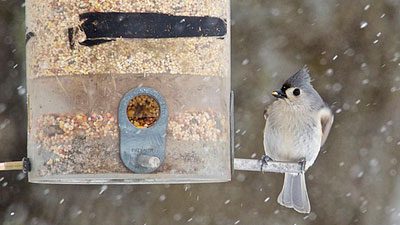
Q. My feeders are being overrun with pigeons and blackbirds who eat all the food and keep the nicer, smaller birds away. What can I do?
A. First consider switching the type of seed you are using. Most seed mixes are more attractive to "problem" birds than they are to chickadees, cardinals, goldfinches, and other feeder favorites. Sunflower seed, particularly striped sunflower seed with its thick, hard shell, is more difficult for blackbirds to open, so switching to that might help.
You might also try bird feeders designed to exclude larger birds. Some have "cages" around them that only small birds can pass through; others close access to the food source when a heavy bird alights on the perch.
Q. I read that I should always make my hummingbird nectar with one quarter cup of sugar for every cup of water, but one of my friends, who gets more hummers than I do, uses more sugar. What's the truth?
A. The sugar content of natural flower nectar varies, and is roughly comparable to sugar water mixtures ranging from a quarter to a third cup of sugar per cup of water. During hot, dry weather, when hummingbirds risk dehydration, it's best to make your mixture no stronger than a quarter cup of sugar per cup of water. But during cold, rainy spells, making the mixture a bit stronger, up to about a third cup of sugar per cup of water, will not hurt your birds and may help them.
Q. All the hummingbird food mixtures I see in stores are red, but my neighbor said food coloring is dangerous. Is that true?
A. There is absolutely no reason to add any red dyes to hummingbird sugar water. After all, natural flower nectar is clear, and hummingbird feeders have colorful parts that attract hummingbird regardless of the color of the sugar water. There is no research that proves red dye is safe for hummingbirds, and very compelling anecdotal information from experienced, licensed rehabbers that hummers who have been fed dyed food have higher mortality and suffer tumors of the bill and liver.
Sheri Williamson, author of A Field Guide to Hummingbirds and Attracting and Feeding Hummingbirds, says, "The bottom line is that "instant nectar" products containing artificial coloring are at best a waste of your hard-earned money and at worst a source of disease, suffering, and premature death in hummingbirds." Red food coloring for hummingbirds? Just say no.
Q. Every summer most of my hummingbirds disappear for a few weeks, and then suddenly reappear in large numbers. What's going on?
A. Adult male hummingbirds aggressively defend their territory, and if your yard is within the territory of one, he may drive all other male hummingbirds away during the nesting season.
If you have a nesting female nearby, she will visit your feeder only periodically, spending most of her time incubating her eggs. After the eggs hatch, she usually concentrates her feeding at flowers that supply tiny insects as well as nectar—insects contain the protein that her nestlings need in order to grow. Once the young have fledged, she continues feeding them for several days until the fledglings have mastered getting their own food. At this time, she may bring them to your feeders to teach them how to take advantage of this easy food supply, too. This is also when males begin migrating, with adult females soon following. So many of the hummingbirds that suddenly appear are actually migrants from farther north, just passing through.
Q. The hummingbirds at my feeder are fighting way too much! My feeder has eight ports—why can't they share?
A. Hummingbirds are aggressive for a good reason—they can't afford to share flowers during times when not many blossoms are available because they may have to wander a long way after nectar is depleted. This aggression is so deeply ingrained that they just can't figure out that feeders are different.
Overall, you'll feed far more hummingbirds by setting out four tiny one-port feeders than one giant eight-port one. Spread them out and the birds won't have to see one another, arousing their territoriality. You'll get to watch them through more windows, and they'll be much happier, too.
Q. I have been told that I should stop feeding hummingbirds in the fall so that they can begin their southern migration. Is this correct?
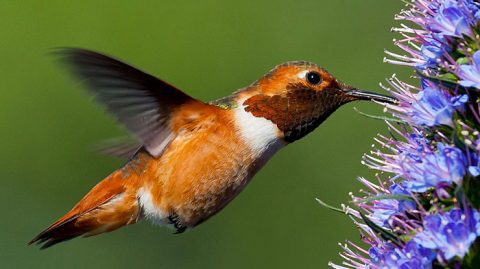
A. That's a myth. A number of factors trigger the urge for birds to migrate, but the most significant one is day length. As days grow shorter in late summer, hummingbirds get restless and start to head south, taking advantage of abundant natural food, and feeders where available, to fuel their flight. A few individuals, especially Rufous Hummingbirds and a few other Western species, wander east rather than south; causes for this have not been entirely teased out, but it's not feeders that cause them to wander, and if a feeding station is closed down, chances are that a vagrant hummingbird will wander toward worse rather than better conditions.
We encourage people to keep hummingbird feeders full for several weeks after the last hummer leaves just in case a straggler shows up in need of additional energy before completing the long journey south. One of our own staff discovered an adult female Rufous Hummingbird at her feeder in northern Minnesota on November 16, 2004; that bird remained for over two weeks, surviving a blizzard and temperatures that dropped to just 6 degrees Fahrenheit, before leaving at mid-morning on December 3. That day temperatures climbed to a relatively warm 25 degrees; the bird's chances of survival wthout the feeder she stopped at were signigfcantly lower.
Q. We have a hawk that comes to our yard on a regular basis, and yesterday he killed a Mourning Dove. How can I get rid of him and keep the songbirds and doves?
A. Hawks that feed on birds apparently take the term bird feeder at face value. If you want to discourage the hawk, you'll have to take your feeders down for a few days, until the smaller birds disperse. In the wild, birds face constantly fluctuating food supplies, so songbirds, doves, and hawks alike will know to search for food elsewhere. Put your feeders up again in a week or two. If you're lucky, the songbirds and doves will quickly return but the hawk will have found hunting grounds somewhere else. You can learn more about feeder problems and solutions at our Project FeederWatch web site.
Q. What should I do if I find algae in my birdbath?
A. Scrub your birdbath immediately if algae start to grow. Use very hot water and a good scouring brush.
Water in birdbaths should be changed at least every three days, and in warm weather even more often. Algal growth is one issue, but even more urgent and potentially dangerous is the possibility of mosquitoes breeding. The mosquitoes that breed in small stagnant pools, such as rain gutters and birdbaths, are the ones most likely to harbor West Nile Virus, which is dangerous for both humans and birds. The importance of keeping water in birdbaths clean cannot be overemphasized.
Also, providing an aerator or a slow drip from an overhanging bottle will attract a wider variety of birds to your birdbath.
Q. There aren't any birds at my feeders. I'm used to having lots of them. What's going on?
A. There's no clear and simple answer to your question. Bird populations fluctuate seasonally and from one year to the next—this is natural and normal. In some cases, birds wander widely, and at the same time that they are declining in one area, they're increasing in another. And local weather and growing conditions can make a backyard more appealing to birds in some years than in others. In other words, it's possible that you're just experiencing normal variation.
But some populations of birds are indeed declining. How can you be sure whether your birds are missing because of normal variation or because they're truly declining? Information from a single place cannot possibly give you a definitive answer, but you will get some excellent clues by visiting eBird. This joint project of the Cornell Lab of Ornithology and National Audubon Society enables bird watchers from around the world to record what they're seeing and share their sightings with others. You can check your county's sightings of the species you're concerned about and go back four or five years to see whether you notice any kind of decline in the data. You can also check reports of those species for other areas to see if the decline seems widespread.
There are several common causes for bird population fluctuations, both locally and on a wider basis.
- Habitat change. Tree removal or harvesting, housing developments, and other changes can reduce the number of birds; the scale of bird losses depends on the scale of the habitat change. When habitat alterations reduce bird populations, usually new species fill the void. Unfortunately, when the change is due to development, often the new species to arrive are opportunistic generalists habituated to humans, such as cowbirds, pigeons, starlings, and geese.
- Fluctuating food supplies. Cones, berries, seeds, and insects fluctuate from year to year, causing birds to move about to take advantage of food surpluses and to escape from areas with food shortages. Many winter finches undergo huge movements, easily seen on a continent-wide basis, because of food supply fluctuations.
- Weather patterns. Droughts, floods, severe storms, exceptional heat and cold waves, and other conditions often cause birds to shift ranges.
- Predator populations. Foxes, birds of prey, and other predators have fluctuating populations. When bird-eating hawks move into an area or snake or fox populations swell, local birds may disappear until the predators move on or their populations ebb. We very much hope that your birds return soon.
Q. Do birds come to feeders because they see the seed or can they smell it?
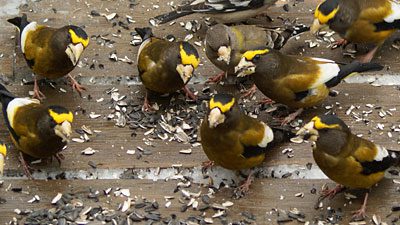
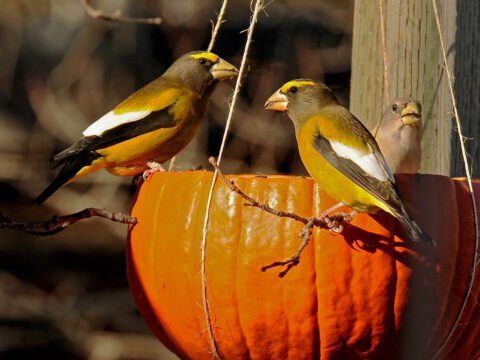
A. Most birds do have at least some sense of smell, but it's very poorly developed in seed-eating species. They are drawn to feeders because they see the seed, see or hear other birds feeding, have learned a "search pattern" for bird feeders, or are very inquisitive and investigate new things on their territory or along their migratory route. Seed eating birds do notice other birds at feeders--by sight and sound--and join them. When Evening Grosbeaks were abundant in the 1980s, they found my feeders before they found most of my friends' feeders, probably because my yard has a box elder tree, with seeds that Evening Grosbeaks especially feed on--they could see those seeds when flying overhead and when feeding in the trees, they could easily notice the seeds on my platform feeder below.
Q. I live in a high-rise apartment with a tiny balcony. Is there any way I can attract birds all the way up on the 17th floor?
A. Depending on what the habitat below you is like, it may take some time for birds to discover your balcony. Bird feeders in high-rises along lakes and rivers are fairly likely to be discovered during migration. Feeders in any neighborhood are more likely to attract birds if there are trees and other vegetation at ground level, and the more plants on your balcony, the more likely curious birds will check it out. Providing food and nectar-producing plants may lure birds in, and will make your balcony more pleasant for you whether or not they ever arrive.
You can learn more about attracting birds to city yards and balconies online with our Celebrate Urban Birds project.
Q. Is there a simple way to get rid of or eradicate starlings? My backyard has many feeders for jays, sparrows, finches, and even hummers. They also get to enjoy several fountains and bird baths. The starlings who have started nesting in the eaves of my garage/shop are now invading my yard, totally unwanted! How can I get rid of them?
A. Starlings can be a huge problem, not just for us people but also ecologically. They appropriate nest cavities from bluebirds and woodpeckers, often killing nestlings and even adult birds. So even beyond the nuisance factor it's a good idea to not subsidize them at feeders. Laws vary somewhat across the country, but it's generally not a good idea, and may be illegal, to kill starlings or any other birds.
Your problem has two prongs: your eaves and your feeders. It might be good first to evict them from your eaves. One way is to hang mylar balloons filled with helium so they're floating about wherever the starlings get access. The unpredictable movements of helium balloons and the shininess of mylar often drive birds away. You can close off all access with hardware cloth or other mesh, but mylar balloons are much quicker and easier and work surprisingly often.
It will be much harder to evict them from your feeders. A good first step would be to close down all your suet feeders for a week or two. If they are visiting some birdseed feeders more than others, you might consider letting those feeders go empty, too. We're right now in the peak of fall migration, so with luck if the starlings' food supplies dry up they will disappear sooner rather than later.
Starlings have softer bills than most seed eaters, so peanuts (in the shell) and white-striped sunflower seed pose problems for them to open, so you might switch to those items while the starlings are still present.
Q. We have 50-75 birds of several species at our bird feeders here in Michigan. Our feeders include suet and seed and must be refilled daily. Do birds store food for the winter?
A. Chickadees, nuthatches, some woodpeckers, jays, and crows store, or "cache," food. Many other feeder birds—doves, sparrows, blackbirds, finches, etc.—do not store food at all.
Do you report your birds to Project FeederWatch? It can be really fun, sharpen your observation and identification skills, and give you a chance to provide valuable data for scientists. A new season of Project FeederWatch is just starting and goes through April. There's still time to sign up!
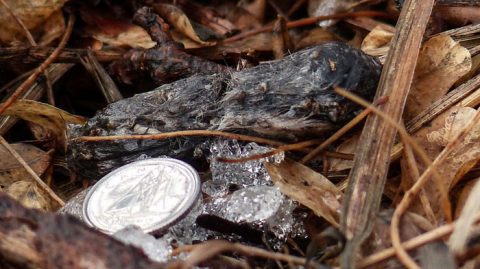
Q. I live in Southern California and recently have noticed small compacted bundles of what appears to be fur and small bones scattered under a large pine tree in my yard. Someone said it is from owls regurgitating what they can't digest. Is this true?
A. This certainly sounds like owl pellets. Owls cannot digest fur, teeth, bones, or feathers. They have two chambers in their stomach. In the first chamber, the glandular stomach or proventriculus, all the digestible parts of an owl's meal are liquefied. Then the meal passes into the second chamber, the muscular stomach or gizzard, which grinds down hard structures and squeezes the digestible food into the intestines. The remaining, indigestible fur, bones, and teeth are compacted into a pellet which the owl spits out.
Owls frequently roost in conifers during the daytime, and pellets may collect underneath their perches. Birders often look for these pellets to find an owl in the branches above.
Browse through owls—and listen to their hoots—in our bird guide.
Q. I recently moved to the top (28th) floor in a high-rise condo building close to the lakefront in Chicago. I was an active bird watcher and had many feeders in my backyard in the suburbs. Do you have any suggestions for feeding/feeders or will I be wasting my time? I have a 13 x 17 foot terrace with glass doors. I would like to put out a feeder.—Michael
A. Your first step will be to set up feeders. To begin with, use small feeders so your seed doesn't spoil before you get any "takers." Try one hanging feeder for nyjer seed and one for sunflower seeds. We recommend suction cup feeders that can be set right on the glass—you dramatically reduce the likelihood of local birds colliding with glass when the feeders are on the glass or set up within just 3 feet of the window.
Once the feeders are in place, try playing recordings of cardinal and House Finch calls and songs (at a normal volume, so that nearby birds may think there's a well-fed bird up there and go join it). In May, you can try hummingbird feeders—the color red may draw some birds in to your feeders. Again, use fairly small feeders at first, and change sugar sugar water at least every couple of days in hot weather or if feeders are in direct sunlight, and every 2-4 days when it's cooler and feeders are shaded.
Keep playing recordings through spring and summer, until birds figure out that your terrace is a good place to feed. Putting up a hanging plant or two will improve your chances of a pair of House Finches nesting. Make sure baskets are set close to the window rather than on the outer edge to reduce the chances that a nestling's first venture out of the nest won't be its last. Setting up other green plants will increase the chances that birds down below will notice your terrace and come up to check it out.
Explore more of our tips about attracting birds to your yard and what to feed them when they get there.
Bird Identification
Q. Now that spring is here, I'm going to start bird watching. What's the best bird identification book out there?
A. The "best" bird identification book is strictly a matter of choice, so different people will give you different answers. The ones people on our staff most often recommend include:
- The Kaufman Field Guide to Birds of North America. This field guide was specifically designed for beginning birders. It uses photographs of birds, but with a layout more typical of field guides using paintings, allowing easy comparison of related species.
- The Peterson guide, A Field Guide to the Birds of Eastern and Central North America, or A Field Guide to Western Birds. Covering just half the continent, these classic guides help you narrow down your choices to the birds where you live. Unfortunately, the range maps are all in the back of the book. You may think you've pinned down the identification of a bird you see in Seattle only to discover, weeks later when perusing the maps, that that species is found only in Arizona.
- The Sibley Guide to Birds focuses on plumage, is very detailed, and includes excellent drawings of birds in different plumages. Because it provides so much detail, fewer species are shown per page, making comparisons a bit more difficult. The original is quite large and heavy, but there are two much smaller versions, The Sibley Field Guide to Birds of Western North America and The Sibley Field Guide to Birds of Eastern North America, that are equally complete (for each half of the continent) and far more portable.
- The Golden guide, Birds of North America, is extremely portable and accessible for beginners.
- National Geographic Field Guide to the Birds of North America is very popular and accessible, but a bit large. The illustrations were done by a variety of artists, so there isn't the single style found in the Peterson, Sibley, or Golden guides.
How do you choose among so many? We recommend visiting a bookstore or library, thumbing through the choices and pulling out the ones that seem most appealing to you. Think of four or five familiar birds, and look them up in each of these books. Which portrays these birds closest to the way you see them? Is the book comfortable to use? Are the birds easy to find in it?
Once you become more familiar with the birds you're seeing, you'll find the All About Birds Online Bird Guide a wonderful reference for more information about each species as well as for photos and sounds of the birds.
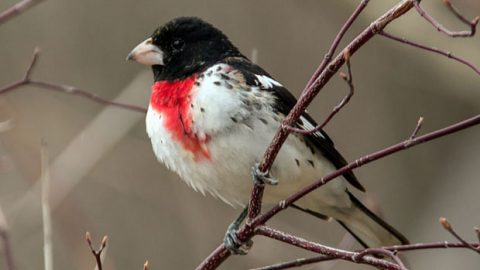
Q. Oh, my gosh! I just saw the coolest bird at my feeder. It's mostly black and white but it has a bright red triangle on its breast. What is it?
A. We always know spring is here when we get this question. It means the Rose-breasted Grosbeak is migrating north. We follow its migration as emails arrive, first from Florida and then a few days later from South Carolina or Tennessee. Take a look at the All About Birds Online Bird Guide and you'll learn more about this beautiful migrant.
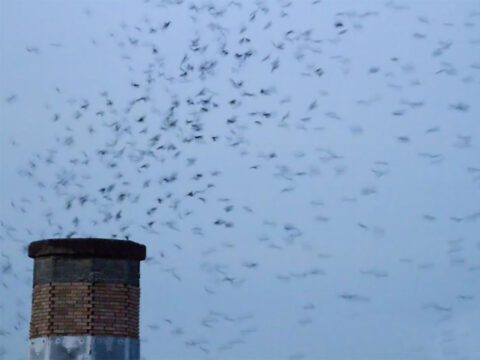
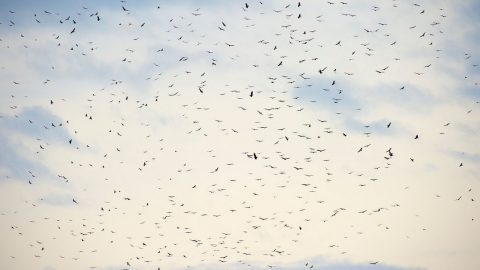
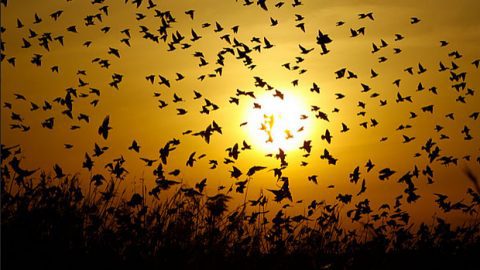
Q. Yesterday evening around dusk I watched hundreds and hundreds of birds flying over my house. What were they?
A. That depends on what they looked like! They could have been blackbirds, grackles, cowbirds, crows, nighthawks, robins, or any other number of species that flock. At the end of summer, when birds finish breeding, many species become more social and join flocks. In the evening, hundreds of them may travel toward roosts and spend the night together.
Q.: There's a bird in my yard I've never seen before. How can I find out what it is?
A. We at the Lab look for four key features for visual identification. While looking at an unfamiliar bird, we try to observe it carefully, looking especially at:
- Size and shape
- Color pattern
- Behavior
- Habitat
We try to take notes about these, some of us sketch it, and if we happen to have a camera, we snap its picture, too.
How does this tell us what the bird is? By looking at the bird's shape, we can get an idea of what family it belongs to. Might it be a duck? A woodpecker? How is the bill shaped? Long or short, stout or thin, straight or curved?
If another bird is nearby, we look at relative sizes. Is our bird sparrow-sized? Smaller than a robin? Larger than a crow? And we look at the shape and size of various features, compared to other features on the bird itself. Are the wings long? Do they extend to the tip of the tail? Is the beak long compared to the bird's head size?
Then we look at overall colors and special patterns. Does it have wingbars? An eye-line? Streaking on the breast or back?
We're also paying attention to the bird's behavior. Does it walk or hop on the ground? Flit out from a tree, grab a bug and flit back? Is it visiting a feeder? Is it alone or feeding with other birds? If it vocalized, what did it sound like?
Habitat is also important. Is the bird in deep forest, expansive prairie, open woods, a marsh or swamp? Your location will also be an important clue to help rule out bird species not found in your region during that time of year.
Now look in a field guide and try to find your bird. This can seem exceptionally frustrating when you're just starting out, and often your bird will disappear before you've even come to the right page. That's where taking notes can help.
If you have some guesses about your bird's identity but still aren't sure, take a look at the All About Birds Online Bird Guide for additional clues about appearance, behavior, and sound.
Even if you don't find this bird, don't get discouraged. Little by little, you'll learn various species, and every time you search through your book you'll grow a little more familiar with where the different species are grouped, making you quicker to find the next one.
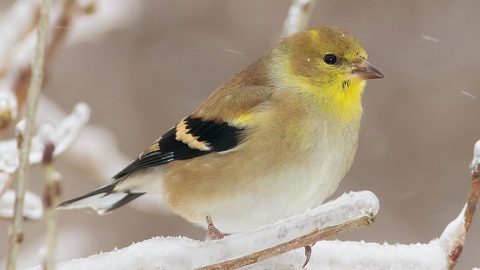
Q. This is the first year I've had a bird feeder, and all summer my goldfinches have been so beautiful! But suddenly they're looking really weird, with ugly dull patches around their bodies the way my children had spots when they had chicken pox. Are these birds sick? Is the food they're getting at my feeder missing something important?
A. Your goldfinches aren't sick—they're molting. Every summer, goldfinches replace their bright body feathers with duller ones for the winter. The new feathers come in one by one, giving the birds that strange patchwork appearance.
Unlike most songbirds, goldfinches molt twice a year. At winter's end, they'll grow in a complete set of new golden yellow feathers. Again each one will have a strange, patchy appearance for a few days, but soon they'll be vividly beautiful again.
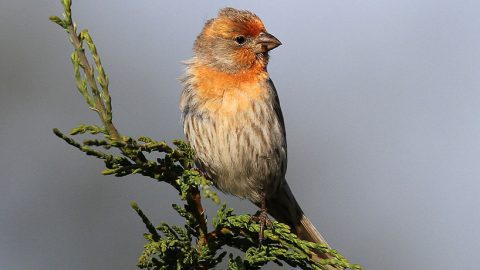
Q. Every House Finch I've ever seen at my feeder has been a pretty shade of red until this year, when two weird ones showed up. One is orange, and the other is yellow! What's wrong with them?
A. Depending on the kinds of food available when House Finches molt, their feathers may be lacking some pigments, and there are also some color variations in different subspecies. Project FeederWatch participants often keep track of interesting birds, including those with unusual color patterns. Read more about House Finch color variations on the FeederWatch website.
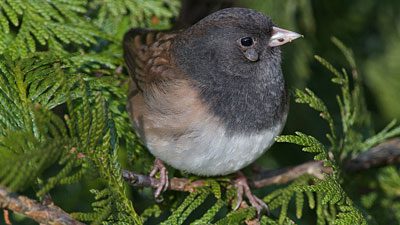
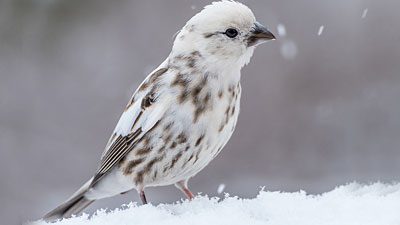
Q. There's a strange partly white bird in my yard. It looks like a junco (or other species) except for some completely white feathers on its head and wing. What is it?
A. If it looks like a junco and hangs around with juncos, it probably is a junco, only this one is what we call a partial albino. Sometimes when skin tissue is injured, new feathers grow in white, and sometimes for genetic or other reasons birds don't produce pigments in patches of their skin tissues.
This can happen with any bird species—you might see a pure white bird shaped like a Blue Jay, or a European Starling whose plumage color looks much paler then usual, or a ghostly white House Wren. Most likely the oddly colored bird really is the more common bird you think it is. Remember that size, shape, and behavior often help to identify a bird even when its plumage looks odd. Comparing the shape of a strange bird with other birds nearby can be very helpful.
Here's the breakdown on albinism and leucism (for info about some other kinds of color variation, see this question):
True albinos in nature are rare, because without protective pigments in the eyes, true albino birds quickly become blind. Also, feathers wear out more quickly without pigments to provide structural support. Albinism usually results from a genetic mutation that interferes with production of the pigment melanin.
Partial albinos are much more common, and most birders eventually see at least a few. Partial albinos have a pied appearance with usually irregular patches of pure white feathers. After an injury, regrowing feathers sometimes lack pigments. Some birds develop stray white feathers as they age.
Another plumage aberration caused by changes in pigments is leucism. Leucistic birds are exceptionally pale all over. They produce smaller amounts of pigments in all their tissues, making the entire plumage look washed out while not being pure white. Plumage patterns typical of the species, such as a mask or wingbars, often remain detectable.
Read more about color variations in birds at the FeederWatch website.
Q. I've heard that birds sometimes show weird color variations that make them look completely different. As a beginner, how can I figure all this out?
A. You're right that some individual birds may appear quite different than the field guides show. Besides albinos, partial albinos, and leucistic birds (see the previous question) you might find a bird with other unusual pigment conditions:
- Melanistic birds have a genetic mutation that results in an excess of dark pigmentation. Some cases also result from diet. Some species have a naturally occurring melanic form (or "morph"), such as the Red-tailed Hawk.
- Birds with xanthochroism may have yellowish or orange plumage instead of red. This may be caused by a genetic variation or by diet.
- Birds with erythrism appear more reddish or rufous than others of their kind. Some species have commonly occurring rufous form, such as the Eastern Screech-Owl and the Ruffed Grouse.
Q. I live in Wisconsin. One of my friends reported a Varied Thrush at our bird club meeting and the next day everyone rushed out to see it. I looked in my field guide, and those are western birds that do not belong in Wisconsin. The next month I was pretty sure I spotted a McKay's Bunting, but when I reported it at the meeting, no one believed me! Is that fair?
A. Finding rare and out-of-place birds can be thrilling, and it's especially fun when our news gets other birders excited. Even a brand new birder will sometimes find a real rarity, but after making plenty of identification mistakes themselves over the years, experienced birders have some clues when a sighting is more or less likely to be accurate.
Although Varied Thrushes do, indeed, belong in the far West, every year individuals wander east. They gravitate to stands of tall conifers often found in towns and cities, so these are one of the more common vagrants to appear in Midwestern backyards.
McKays's Buntings, on the other hand, do not wander south regularly. These pretty and distinctive birds would not be confused with any other species, if only every bird had normal plumage. But many partial albino birds can have huge white patches that make the bird look like a McKay's Bunting. It's quite possible that some of the birders in your local club had mistaken a partial albino House Sparrow, junco, or other bird for a McKay's Bunting when they were starting out, and they know what an easy mistake that is.
Q. Why are some species found out of their normal range more than others?
A. Some species wander more regularly than others. Many winter finches, such as crossbills and Pine Grosbeaks, may arrive en masse in response to scarce food in their northern homes. Snowy Owls may wander south when the population of their favored food, lemmings, plunges. Irregular migrations such as these are termed irruptions.
Migrating birds may be blown off course by the strong winds of hurricanes and other violent storms, or grounded by fog, heavy rain, or other adverse weather conditions.
Some birds, often juveniles, disperse northward after the breeding season in what is referred to as post-breeding or vagrant wandering. This is especially common with some herons and ibises.
Occasionally birds appear in new areas by migrating in a direction opposite to that expected, referred to as reverse migration. One theory to explain this is that their internal navigational system is malfunctioning. This may explain sporadic appearances of Fork-tailed Flycatchers in North America.
Individuals of some species, particularly western hummingbirds, wander east/southeast during autumn. No one has teased out exactly why this seems to be happening more often in recent decades than in the past.
Remember that range is a dynamic concept, and species' ranges change over time, albeit usually quite slowly. Tufted Titmice and Northern Cardinals, for instance, live much further north than they did 100 years ago.
Q. I saw a rare bird. Am I supposed to tell anyone? Will they believe me?
A. If you are fortunate enough to see a rare bird, you should take careful notes about what you see, describing plumage color patterns, beak shape, eye color, behavior, habitat, vocalizations, and any other features that will aid in identification. Draw a sketch of the bird noting any distinctive characteristics or, better yet, try to take a photograph or video of the bird in action. If you're inexperienced at documenting rare birds, you might want to call a trusted, more experienced birder to see if she or he can confirm your sighting. Your careful documentation of this bird will help you build your skills and also ensure that your report becomes part of the scientific record.
Once you're absolutely certain of its identification and have written down your documenting description, Report it to your local bird club, Rare Bird Alert, or Audubon chapter, and make sure to report it on eBird. Don't feel defensive if you're questioned about all the details. It is essential for official records to be accurate, and the overall feeling is that it's best to leave out some legitimate sightings that aren't well-enough documented than to include some inaccurate ones. Virtually every birder has had at least one sighting rejected by a state organization. This is not a commentary on your birding skills or a judgment of what you've really seen, but simply a conclusion, usually by a committee, that there is at least a remote chance that your bird may have been something else. Usually their findings will be very helpful in teaching receptive birders (and not just the one whose report was rejected!) what features to look more closely at, and what other possibilities to take into account when documenting a rare bird.
Q. There are so many field guides to choose from! How do I pick one?
A. Begin by browsing the field guides at the library or bookstore to get a sense of which one works the best for you. Most experienced birders prefer a field guide with drawings by an expert rather than with photographs. Good bird artists portray birds in similar poses, using their experience and knowledge to make it easier for you to key in on the important field marks. With photographs, lighting conditions and differences in bird postures can obscure important features or highlight unimportant ones, although the photos in some well-done guides are digitally manipulated to make color comparisons among different species more accurate.
Size is very important with a field guide, because if your book is too large, you won’t want to carry it in the field, but if it’s too small, it may not include all the birds you’re likely to see in your area. If you hope to eventually become proficient at birding, it’s wise to start with a guide that shows all the birds of North America or at least all the birds of the East or the West.
Hawaii’s Birds, a small guide published by Hawaii Audubon, is the only field guide with complete coverage for a single state. Other than that one, I never recommend using guides that show the birds of a single small area — almost every beginner sees at least a few species in the first several months of birding that aren’t included in more minimalist guides, leading to misidentifications and frustration.
Keep these things in mind as you browse through several field guides, and pick a few that seem best on an overview.
Now look up two or three birds that you’re very familiar with in each one. In your judgment, which seem closest to how you’ve experienced those birds? Consider color and poses. Also, how easy is it to find each of these familiar birds in the book? Remember: With field guides as with optics, there is no “best.” Beyond a few basic issues, it’s a matter of personal preference.
Q. I observed 25-30 birds in my orange tree that appeared to be female cardinals but I've never seen that many together before. These birds had a very prominent top knot.
A. Your birds were probably Cedar Waxwings. You're absolutely right that cardinals aren't a flocking species, but Cedar Waxwings are. Not only are they far less territorial than cardinals, they're surprisingly cooperative. Flocks are often seen passing a single berry or petal down the line until one bird finally eats it. They nest close to one another, and may not defend a territory at all.
Waxwings are a bit plumper than cardinals, with warmer brown plumage accented with red and yellow. You'll find more photos, sounds, video, and facts about them at our Cedar Waxwing page.
Q. I’m interested in doing more than just looking at my backyard birds, but isn’t birding an expensive hobby, with state-of-the-art equipment and a lot of travel?
A. Birding doesn’t have to be expensive, though it certainly can be for those who purchase the best optics, the most current electronic gadgets, and the airplane tickets to embark on world travel. But it can be equally satisfying, and sometimes even more so, to watch birds while spending very little money.
You can have years of enjoyment with excellent binoculars costing less than $300 that will allow you to identify as many birds as those top-of-the-line ones. Investing $30 in a field guide can provide a lifelong reference for learning about hundreds of birds in your own area and anywhere else you may go in North America. And birding locally can provide endless enjoyment and excitement as you hone your skills and continually learn more about the diversity and behavior of birds.
Read more about birding on a budget in BirdScope.
Q. My husband bought me a really great pair of binoculars, but whenever I try to look through them, everything sort of blacks out and I can’t see a thing. How can I adjust them?
A. Considering how expensive binoculars can be, it’s odd that most companies don’t include operating instructions in the package. Using binoculars is like riding a bike —wonderfully easy, once you have the hang of it.
Before you try to see birds through your binoculars, you need to make a few adjustments. Virtually all binoculars have several helpful features that allow them to be tailored to different users. The eyecups hold the ocular lenses (the lenses you look through) exactly the right distance from your eyes (this distance is called eye relief), to optimize magnification and cut out peripheral light, making the image clearer and brighter. Extend the eyecups if you don’t wear eyeglasses. Since eyeglasses hold binoculars away from the eyes and let in peripheral light anyway, retract the eyecups if you do wear glasses.
Next, set the barrels of the binoculars to match the distance between your eyes. Looking through them, adjust the barrels until you have a solid image through both eyes. If the width isn’t set properly, your image will black out.
Virtually all binoculars on the market have center focusing, in which a single knob or lever controls the focus for both eyepieces simultaneously. Our eyes are seldom precisely matched, so to accommodate the difference between our two eyes, binoculars also have a diopter adjustment near the optical lens on one side or the other, or as part of the center focus knob. Diopter adjustments are normally numbered from +2 to –2. Here’s how to adjust the diopter so you can use your binoculars without eyestrain:
- 1. First find the diopter adjustment and set it at zero.
- 2. Find something a good distance away that has clean lines. A sign or something else with letters or numbers is often a good choice.
- 3. Cover the objective lens (the large outside lens of the binoculars) with the lens cap or your hand on the side controlled by the diopter adjustment, and then focus on the sign using the center focus knob. Try to keep both eyes open as you do this.
- 4. Switch hands, uncovering the lens with the diopter adjustment and covering the other lens. Focus again, this time using the diopter adjustment, not the center focus.
- 5. Repeat a couple of times to make sure. After you’re done, your sign should be crisply focused through both eyes.
- 6. Notice the number setting on the diopter adjustment. Sometimes during normal use, the adjustment knob may get shifted, so every now and then when you start using them, check to make sure it’s set where it should be for your eyes.
Finally, make the neck strap as short as it can be while still allowing you to use the binoculars comfortably and put them over your head easily. The longer the strap is, the more the binoculars will bounce, and the greater the chance you may bonk them against rocks, tables, and other objects whenever you bend down.
If you're new to birding, watch our free how-to video series, Inside Birding, to get started on identifying birds with confidence.
Q. I've just upgraded my optics. What should I do with my old binoculars?
A. Many birders keep their old optics on a closet shelf just in case anything happens to their new ones. As insurance, this isn’t a bad idea, but if your old optics are in usable condition, you may want to put them to work so that others can enjoy birds and protect their future. How? Donate your old optics to a local nature center or birding club, or to an organization such as the American Birding Association’s Birder’s Exchange, or to Optics for the Tropics. Both organizations send used (and sometimes new!) binoculars to researchers and educators in Latin America and the Caribbean.
Information about Birder’s Exchange is on the ABA website at www.americanbirding.org/bex, and about Optics for the Tropics at www.opticsforthetropics.org.
Migration
Q. How do hurricanes affect migrating birds, and is there anything we can do to help the birds that have been negatively affected?
A. Each year, migratory birds cross the Gulf of Mexico during hurricane season. Most birds wait for favorable winds and weather before starting a migratory flight, so seldom strike out over water during a hurricane, but some birds may be well offshore when a storm begins. Although migrants have enough fat (fuel reserves) to make the 600-mile Gulf crossing in favorable winds, they may not have enough energy to survive if they have to fight against headwinds.
Before and after flights, when migrants have higher than normal food requirements, they may have problems finding safe supplies of food in areas devastated by storms. Resident birds in hurricane areas also suffer when their food supplies, such as fruits and berries, are stripped from trees and shrubs. Like migrants, they may wander to other areas in search of food. Preserving critical coastal habitats is essential for these birds. It's also crucial for them that we enforce strict regulations to prevent hazardous materials from leaking or spilling during storms and floods.
Large storm systems may drive some birds far off-course. Strong-flying birds often move ahead of the storm, carried by the winds at the forefront of the weather system. Brown Pelicans, Magnificent Frigatebirds, and other oceanic birds have been recorded far inland, sometimes more than a thousand miles from the coast, after hurricanes. Some of these birds may find their way back; others, unable to deal with the unfamiliar terrain or to find appropriate food in freshwater, may die.
Birds and hurricanes have coexisted for millennia, and given the chance, healthy bird populations rebound from the effects of such natural disasters. Unfortunately, humans make this difficult for some birds because we have destroyed so much natural coastal habitat, and so nowadays hurricanes pose greater threats to vulnerable bird populations than they once did. Working to preserve and restore as much coastal habitat as possible, to minimize toxic spills and leaks during storms by enacting and enforcing strict regulations, and to keep bird populations healthy year round are our best strategies for minimizing the long-term effects of hurricanes on birds.
Q. What happened to all the robins? I'm not seeing them any more.
A. Every year in late summer and fall, robins leave the areas where they've raised their young, switching their diet from mostly earthworms and insects to mostly fruit, and switching their behavior from territorial defense to social flocking. They spend fall and winter in large flocks, traveling to places where they can find more food.
Fruit has what we call a "patchy" distribution. In a given year, crabapple trees in one area may be dense with fruit while in another area produce virtually nothing. This may be reversed in another year. One cherry tree may be filled with many pounds of fruit, yet be miles away from the next cherry tree. So robin flocks move about, with many eyes searching for fruit-laden trees and shrubs. During one winter, an area may have hundreds of thousands or even millions of robins, and the next year have virtually none, all depending on that year's fruit availability and how much fruit robins are finding elsewhere. When fruit is abundant, some robin flocks may remain in far northern places throughout the winter. Robins are surprisingly hardy birds, capable of surviving temperatures well below zero as long as they have enough food. Wherever they are, north or south, when a flock depletes the food supply in one area, they move on.
Robin flocks stay together throughout the winter, but as days lengthen, they grow more restless, and the direction of wandering flocks turns northward. Although some robins may spend the entire winter in the north, the bulk of them end up in central and southern states. The leading line of their spring migration tends to follow the 37-degree isotherm (the line where the average 24-hour temperature is 37 degrees), and as individuals reach the general area where they will breed, and as worms become available, individuals grow increasingly restless and territorial. This is when individuals start singing, and when competing territorial birds start fighting.
Robin sightings reported by participants of the Great Backyard Bird Count show that robins tend to avoid areas with deep snow cover. Is this because even with their reliance on fruit, they still prefer to search for some soil invertebrates? Is snow depth correlated with fruit availability? We're still teasing out the answers to many of these questions, but you can read more about these robin findings on the Great Backyard Bird Count web site.
You can help scientists document the seasonal movements of robins by participating in the Great Backyard Bird Count in February of each year, by reporting your nesting robins to NestWatch, and by reporting your sightings year-round to eBird . The latter of these is an online checklist program which allows you to keep track of your own bird lists, see the changes in numbers throughout the year, and explore maps showing where else the birds are being seen.
For more information about robins, including a map showing their summer and winter ranges, visit our Online Bird Guide.
Q. I have a hunch that the bird singing outside my window is the same one who nested here last year. Could that be true?
A. This is quite likely. Many migratory songbirds return to the same local area, and often to the exact same territory, each spring, even after traveling thousands of miles to and from their wintering grounds. Migratory songbirds tend to have short lives (annual mortality rates are about 50 percent), but birds that survive their first winter to breed in your yard have a higher chance of surviving year to year. Studies of banded birds show that 20-60 percent of migratory songbirds are likely to return to the same local area at least two years in a row.
Q. How do birds prepare for long migrations?
A. As days shorten at summer’s end, photoreceptors in their brains trigger hormonal changes that stimulate many birds to molt into new feathers that will stand up to the rigors of a long flight. Their hormones also trigger a huge appetite, and they start eating voraciously, gaining significant amounts of weight. Many insectivorous species supplement their diet with fruits, grains, and other items that can be converted to body fat, which birds burn efficiently for energy. These hormonal shifts make birds increasingly restless, especially at nighttime. Suddenly, one day it’s time to go!
I've heard you can tell if birds are migrating on a particular day by looking at a weather map! How does that work?
A. It's true. Weather radar images show where radar beams have been "reflected" as they sweep the atmosphere. They're useful for showing weather conditions because the beams are reflected by precipitation and the water vapor in clouds, but they can also be reflected by swarming masses of birds or insects.
In the early days of World War II, British radar operators noticed mysterious, ethereal shadows drifting across their screens. They weren't associated with weather systems and so the radar technicians nicknamed them "angels." In 1958, a New Orleans high school student named Sidney Gauthreaux, realizing that these "angels" were really the radar reflections of swarms of birds, started scrutinizing radar images. As a Louisiana State graduate student, he worked with radar images to document the existence of massive trans-Gulf migrations. In the late 1980s, Gauthreaux started examining archival radar images and made a disturbing discovery: major bird movements over the Gulf had declined by nearly half since the 1960s.
Next Generation Radar (NEXRAD) made studying bird migration much easier. The Air Force started using it to avoid collisions in their Bird Aircraft Strike Hazard program. Graduate students took stunning images of giant expanding aerial doughnuts, which they found to be thousands of Purple Martins radiating from critical roosting sites each morning. Now it's easy for anyone with access to a NEXRAD weather map on their computer to see birds take off on migratory movements at night or alight in the morning, if you know how to interpret the mystifying patterns. You can learn how at Gauthreaux's website at Clemson University.
Q. Last night, maybe 1AM, I heard a flock of birds fly overhead. They sounded like Trumpeter Swans perhaps. But in the night? (I live on the east coast of Vancouver Island on the west coast of Canada.)
A. Swans, geese, and ducks migrate both by day and by night, so it's quite likely you were hearing Trumpeter Swans. Most songbirds migrate by night as well. Standing outside listening is a wonderful way to appreciate the magnitude of nocturnal migration.
You can also view the magnitude of a night's migration using NEXRAD weather radar. If you're interested, Braddock Bay Bird Observatory offers a good example of using radar to see bird migration. Try this site to learn how to identify flight calls of nocturnal migrants. Or just train your spotting scope on the full moon and see how many birds pass by!
Birds vs. People
Q. I discovered a bird nesting in a shrub next to our house. We're planning on having the house painted next week. What should I do? Can I move the nest?
A. If it is possible to delay the painting for a month, and you can wait for the young to leave the nest, that would be the best solution for the birds. If that is not possible, then ask the painters to minimize their presence around the nest. Although there is a risk the bird will abandon the nest, many yard birds are tolerant of occasional disturbances. If you move the nest, there is a very good chance that the bird will abandon it.
Q. A bird built its nest in my boat. I'm going to need that boat in a few weeks. I don't want to hurt the bird or any babies, but how long before I can use my boat again?
A. If you've been using your boat all along, the birds won't mind your continuing to use it. But if you've been away from the boat from the time they started building, taking the boat out may indeed cause the parents to abandon ship.
Because each bird species is different, I can't tell you exactly how long you'll need to wait. However, I can give you a few guidelines. Birds usually lay one egg a day. They don't begin incubating their eggs until all the eggs have been laid. Clutch sizes vary from 2 to 8 eggs for most common backyard birds. Once the last egg has been laid, incubation takes about two weeks. The eggs will usually hatch around the same day. From that point, it will take another two to three weeks before the nestlings are ready to leave the nest. To be on the safe side, and to allow for the worst-case scenario, you should probably allow six weeks before planning on using the boat. If you're kind enough to make this sacrifice, thank you!
All About Birds is an excellent resource for finding out information about birds in general and about incubation and fledging times for individual species.
Q. I have a small, five-pound dog that likes to run around our backyard. Should I be worried that a hawk or owl could pick him up and take him away?
A. Although most small dogs are too heavy for a hawk or owl to actually carry, it's still possible for large raptors to attack and kill them. A five-pound dog is no bigger than a large rabbit—a hawk might easily attack and carry it away. Of course, a dog this size is also in danger from foxes, coyotes, bears, raccoons, and even other dogs, so it might be wise to let your dog out only when accompanied by you. If hawks present a significant danger because you live on a raptor migration route or have hawks nesting nearby, seriously consider getting a second dog. Hawks are far less likely to attack one dog when another, even one equally small, is nearby.
A kennel with a wire roof can also protect small dogs, not just from hawks and owls but also from other predators and human dognappers.
Q. I have a pond behind my house that I've stocked with fish. Several herons have been taking fish from the pond. I don't want to harm the birds, but I do want to stop them from taking these fish. Do you have any suggestions?
A. I can certainly understand not wanting the birds to eat expensive fish! Of course, the birds have no concept of the value of koi, and are simply doing what they do best: find and eat fish.
To get herons to pursue their livelihood elsewhere, people have tried a variety of techniques. Unfortunately, we at the Cornell Lab of Ornithology have different goals, and actively encourage herons to visit our pond here in Sapsucker Woods. For suggestions, visit the Royal Society for the Protection of Birds web page on deterring herons. The Gray Heron of Great Britain is quite similar to our Great Blue Heron, so ways of dealing with either will be quite similar.
Audubon At Home has tips about using heron decoys to keep real Great Blue Herons away; find them on their website
You can read about the Great Blue Heron and other herons and egrets in the All About Birds Online Bird Guide.
Q. There's a huge starling roost near my house and they're driving us nuts! What can we do?
A. The European Starling is an exotic species that was introduced to North America in 1890 and 1891. It's now a permanent resident across the United States and Canada, almost always near areas of human habitation, disturbance, or agriculture, so is seldom found away from cities, suburbs, parks, and farms. As you've figured out the hard way, the European Starling is considered a "problem" bird for several reasons:
- It competes fiercely for nesting cavities, ousting such native birds as bluebirds and various woodpeckers, sometimes even killing them.
- It is aggressive at feeders, keeping smaller birds away and consuming large quantities of seed and suet.
- Its enormous winter foraging flocks are considered pests in agricultural areas.
- Its huge winter roosts present hygiene challenges where humans live.
- Roosts are very noisy.
Unfortunately, discouraging starlings from roosting around your house can be difficult at best. Installing a plastic model hawk or owl in a tree may help for a short time, but if that's all you do the birds will soon realize it poses no threat and ignore it. Many people recommend using a predator decoy in combination with another bird deterrent, such as a recording of starling distress calls broadcast through a loudspeaker, though starlings tend to habituate to these noises much more quickly than people do. A sudden loud noise may flush starling flocks from your trees, at least the first few times you try it. Some people use fireworks, or clang pots and pans together. Sometimes even just clapping your hands is enough to flush a starling flock, once or twice. But starlings are usually more persistent than people are, and least adjust to even sudden noises more quickly than we do.
Any time you notice even a single starling hanging out near your house, try to chase it away. Be persistent from the beginning to avoid having a flock become established in your yard. It's much harder to get a flock to move once they've settled in at a roost site.
One of the most effective ways of driving a starling roost away involves a particular kind of professional help. Call your local game warden or a department of environmental conservation to find out if any falconers live near you. If you can enlist the aid of falconers to come for a few visits, their birds may get a bracing hunting experience that sends the starlings packing for good.
Q. Why do woodpeckers like to hammer on our homes?
A. Researchers at the Cornell Lab of Ornithology are studying damage inflicted on property by woodpeckers. We invite you to learn more about this problem, including the reasons why the birds may have selected your house, and possible deterrents. Visit the Woodpeckers: Damage, Prevention, and Control site.
Q. A Yellow-bellied Sapsucker is destroying my beautiful tree! What can I do?
A. Sapsuckers tap for running sap in the springtime, circling a trunk or large limb with their tiny drill holes, and when those wounds heal over, drills a whole new ring of holes. Surprisingly, most trees survive this quite easily, in the same way that maple trees survive humans tapping for syrup. And the sapsucker wells are vitally important for other birds, supplying a reliable source of food for hummingbirds, kinglets, Cape May Warblers, and other species, especially when they're first returning in spring. We at the Cornell Lab of Ornithology have named the beloved woods about our laboratory Sapsucker Woods, so you just know we're going to take the birds' side in this.
That said, there really are some trees that people shouldn't have to risk losing. If the woodpecker isn't working too high, the easiest, and usually most effective, way of sending a sapsucker off is to wrap the tree in burlap, over a wide enough section that it doesn't start a new ring of holes. Many birds are alarmed by bright Mylar balloons filled with helium, which wave about in a way they can't predict, so tying a few around your tree should provide additional insurance that it doesn't just start digging in a new place in the same tree. By the time the helium has dissipated, the sapsucker should be long gone.
Q. A bird is singing all night long outside. Short of changing the front yard landscape, what do I need to do to quiet this bird? I lay awake almost every night listening to this bird just outside my window. Eventually, I get up and shake the tree until the bird takes flight. Is there an easier way to "get rid" of it—at least until sunrise?
A. The Northern Mockingbird is typically the culprit in these all-night song marathons. Mockingbirds who sing all night long tend to be young, still-unattached males or older males who have lost their mate, and so the best way to shut him up is to entice a female mockingbird to your yard, too. He's already doing his best to accomplish this, though to the disappointment of both of you, he's not succeeded yet.
One thing that very well might work would be to cover your tree with bird netting—the kind sold in gardening stores to keep birds out of fruit trees. You'll need to check on it occasionally, since sometimes tiny birds get entangled in it, but you can do that in the daytime after a good night's sleep. And maybe by sending your bird elsewhere, you can sleep and he can be more effective in attracting a mate. Good luck, and please let me know what happens.
I don't know if it will help to know that the mockingbird was Thomas Jefferson's favorite bird. He wrote a lot about its amazing mimicry abilities and songs, and how England had nothing to compare with it, in his Notes on the State of Virginia. He also had a pet mockingbird named Dick who lived in the White House.
Robert Frost's poem, "A Minor Bird," will be less than consoling, seeming rather judgmental for someone who just wants a decent night's sleep:
I have wished a bird would fly away,
And not sing by my house all day;
Have clapped my hands at him from the door
When it seemed as if I could bear no more.
The fault must partly have been in me.
The bird was not to blame for his key.
And of course there must be something wrong
In wanting to silence any song.
Because of course there must be something right about wanting a decent sleep at night.
Q. Are turkeys bred and eaten in Europe?
A. Yes. The Wild Turkey is native only to the Americas, but Spanish traders brought some domesticated by Incas and other indigenous Americans to Europe and Asia in the 1500s. The bird got its common name because it typically reached European tables through shipping routes that passed through Turkey. On a continent where fine dining still included eating storks, herons, and bustards, the meaty, succulent turkey was a sensation.
When English settlers came to America, they were amazed to find the same birds running wild and free, and tasting really good thanks to their natural diet of chestnuts, beechnuts, walnuts, and other native mast. That is probably one of the reasons Ben Franklin wanted the turkey to serve as our national emblem—it's a beautiful, genuinely American bird that tastes wonderful and had enormous economic value for the colonists.
Read more at our Wild Turkey page, or at this Smithsonian page, The Eat-ymology of the Turkey.
Q. Can you give me a list of the birds most frequently seen, or known to reside, in the Gulf of Mexico? I cannot seem to find a list anywhere on the Internet. If the list is too extensive, could you tell me which birds in the Gulf area are endangered or threatened (especially by the BP oil spill)? —Lynn
A. Hundreds of bird species live in the beaches, marshes, and forests along the Gulf of Mexico, and hundreds more migrate through the region on their way to breeding sites as far north as the Arctic. As an example, eBird participants last year reported a total of 401 species in the state of Louisiana alone.
The U.S. Fish and Wildlife Service has compiled a list of the endangered and threatened species that could be harmed by the current oil spill (download fact sheets here). The list includes Piping Plover, Wood Stork, Whooping Crane, and Roseate Tern, along with many mammals (including the West Indian manatee), all four Gulf species of sea turtles, and several species of fish and plants.
A separate Fish and Wildlife Service fact sheet emphasizes the Gulf Coast's importance for shore-nesting birds. The coastlines of Louisiana, Mississippi, Alabama, and the Florida panhandle support a disproportionate number of Brown Pelicans, Wilson's Plovers, Black Skimmers, Sandwich, Forster's, Gull-billed, Least, and Royal terns, Laughing Gulls, and Snowy Plovers.
About three-quarters of the southeastern U.S.'s Sandwich Terns live along the northern Gulf Coast, with one of the world's largest colonies on Breton National Wildlife Refuge, which is unfortunately situated very close to the leading edge of the BP spill.
Another way to keep track of birds along the Gulf Coast is with the eBird Gulf Coast Oil Spill Tracker. This is a Google gadget that's easy to embed on your own web page or blog—or you can bookmark our home page and check it there. It provides a map of recent sightings made by eBirders along the Gulf Coast, for 10 especially vulnerable bird species. Bird watchers who live near the Gulf Coast are encouraged to look for birds and report their sightings to eBird, to aid efforts to understand the effects of the spill.
Follow more oil spill news on our blog as this situation develops. Despite the harrowing prospects, we all hope for a quick end to the oil leak, a safe recovery for the birds and wildlife of the region, and a return to prosperity for the hard-working population of the Gulf Coast.
Q. This afternoon I opened my door and a beautiful white and gray dove walked into my garage. It went to an empty hutch so I gave it fresh water and food. It was very tame. One leg has a plain green band and
the other leg has a red band with numbers on it. What should I do?
A. This sounds like a domestic racing or homing pigeon. Sometimes
these birds become exhausted and need just a few hours or days to rest
or feed before they head home again. Sometimes they are injured or
lost. In some cases, owners who want to maintain a competitive racing
flock don't want their birds back again, but more often tracking down
the owners can be a genuine kindness.
When scientists put bands on wild birds, they use metal bands issued
by the U.S. Fish and Wildlife Service. Racing and other domestic
pigeons never wear these bands; their owners use different bands
usually registered with either the American Racing Pigeon Union
(http://www.pigeon.org/lostbirdinfo.htm) or the International Federation of American Pigeon Fanciers (www.ifpigeon.com). If you can read the leg band numbers, you can contact these organizations to try to track down the pigeon owners.
Did you know that some of Charles Darwin's revelations about evolution
came from the many years he spent raising pigeons? Read about it in Living
Bird magazine.
Bird Sounds
Q. Why do some birds mimic the sounds of other species?
A. Although some birds learn their species' song during their first year of life, others, including mockingbirds, continue adding to their repertoire as they grow older. Northern Mockingbirds can learn as many as 200 songs, and often mimic sounds in their environment including other birds, car alarms, and creaky gates. One theory is that if a female prefers males who sing more songs, a male can top his rivals by quickly adding to his repertoire some of the sounds around him. Possessing a diverse assortment of songs may indicate he is an older male with proven longevity and survival skills--good traits to pass on to offspring. An older male may also be more experienced in raising young or may have access to better resources. According to one study on the Edwards Plateau in Texas, mockingbirds with the largest repertoires have the best territories, laden with foods such as insects, wild grapes, and persimmons.
Some researchers have suggested that mockingbirds may use other species' songs to warn those species to keep away from their territories, but this possibility has never been thoroughly investigated.
In North America, the Northern Mockingbird is perhaps the best known mimic, but renowned mimics, such as the lyrebirds of Australia and the Lawrence's Thrush of South America, occur on other continents too. Male Marsh Warblers learn the sounds of other species on their wintering grounds in Africa. Perhaps these varied sounds impress potential mates when they return to breed in Europe. Indigobirds in Africa are also mimics, but for an entirely different reason. Indigobirds are brood parasites that lay their eggs in the nests of other species. For example, the Village Indigobird lays its eggs in the nest of the Red-billed Firefinch. Young indigobirds learn the begging calls of the firefinches that raise them so they will not be recognized as an intruder. Young male indigobirds also mimic their hosts.
The female Thick-billed Euphonia is a Neotropical bird that imitates the alarm calls of other species when her nest is threatened. These sounds may get the attention of other species to help in the attack of a predator or other perceived threat.
Some species not typically thought of as mimics also occasionally learn the vocalizations of other species. Blue Jays imitate the calls of Red-tailed, Red-shouldered, and Broad-winged hawks, for example. The function of these imitations is unknown.
In some cases, mimicry may result from the song-learning process gone awry, such as reports of a Vesper Sparrow and House Wrens singing songs of the Bewick's Wren, and an Indigo Bunting and a Common Yellowthroat singing a Chestnut-sided Warbler song. It seems that a fairly large number of these occasional mimics are unpaired, suggesting that males who learn the wrong songs often fail to pass their genes to the next generation. Selection against birds who learn the wrong songs may thus be very strong, so "mistakes" are not perpetuated. (Source: The Cornell Lab of Ornithology's Handbook of Bird Biology)
Q. Which birds are the best mimics?
A. In North America, mockingbirds, thrashers, and catbirds are often referred to as mimic thrushes (although they are not members of the thrush family) because of their skills at mimicking other species. The Brown Thrasher can sing up to 2,000 different songs and may be the champion mimic in North America. European Starlings are also accomplished mimics. As noted above, Blue Jays can mimic several species of hawks.
Parrots are especially adept at mimicking sounds and human language. Unlike songbirds, which produce sounds by vibrating membranes in two different syrinxes, parrots have only one syrinx, located at the bottom of the windpipe. This is somewhat similar to humans, who also have only one sound-producing organ, the larynx. Parrots also have long, muscular tongues that may be used in modifying sounds. Parrots also have forebrain areas involved in vocal learning and control of vocalization that are not found in other birds.
African Gray Parrots are one of the most accomplished mimics. A bird named "Prudle", a male African gray, is listed in the Guinness Book of World Records as having a vocabulary of more than 1,000 words. The Animal Planet network featured an African Gray Parrot that lives up to his name--Einstein.
Q. Do parent and baby birds recognize each other's songs or calls?
A. Adult birds may or may not recognize their young, depending on the species and nesting habits.
The Brown-headed Cowbird lays its eggs in the nests of other species. The host species does not seem to notice the difference between the calls of their own babies and that of the cowbird.
Adults of species such as Barn Swallows never learn to recognize the calls of their own young. This pattern may have developed because the young birds become independent immediately after fledging or because they remain isolated in their family group until they are fully independent.
In colonial species the situation is very different. Within a few days of hatching, adults learn to recognize the voices of their own chicks, and vice versa. Herring Gulls, for example, may accept tiny young into their nest for a short period after their own eggs have hatched. After two to three days, however, they will not allow strange young into their nesting area.
Q. Do bird songs have frequencies higher than humans can hear?
A. The frequency range of human hearing is often reported to be between 20 and 20,000 Hz. As we grow older, we all tend to lose the ability to hear higher frequencies.
Many bird songs have frequency ranges between 1,000 Hz and 8,000 Hz, which places them in the sweet spot of human hearing. On the high end, many warblers, sparrows, waxwings, kinglets, and a number of other birds produce sounds that reach 8,000 Hz and beyond. Examples of the frequency ranges of bird songs:
- Brown Creeper: from 3750 to 8000 Hz
- Cedar Waxwing: from 6000 to 8000 Hz
- Blackpoll Warbler: from 8000 to 1020 Hz
- On the low end, Dwarf Cassowaries in New Guinea have been recorded giving calls as low as 23 Hz.
You can test your own hearing by visiting a web page from the University of Kentucky, "Frequency Response of the Ear." You will have a choice of frequency ranges. Keep in mind that the frequency response of the speakers attached to your computer, especially internal speakers, will have a limited frequency response range. This will often fall between about 100 and 10,000 Hz. Check the specifications on your speakers to determine their frequency range.
Q. What is the most beautiful bird song in North America?
A. Some people believe the thrushes, such as the Wood Thrush, or the Veery, have the most beautiful bird songs. Many people love the cry of the Common Loon. Click on the links and listen to their songs. See if you don't agree. If you don't, what is your favorite song? Why is it your favorite? Let us know and we'll post some of the answers.
Q. Why are Blue Jays far more noisy in fall than earlier in the summer?
A. Early in the summer they're nesting, and being as secretive as possible. Now families have joined flocks and are migrating to new areas. It's right in the middle of hawk migration, too, so they're all squawking their heads off about new food discoveries, predators, greeting relatives and old neighbors, and they're no longer concerned about predators finding their nests.
Find more photos, sounds, video, and text on our Blue Jay page.
Q. Are starlings known for their mimicry? My neighborhood starlings make some unusual sounds, including imitating cats and my boyfriend's motorcycle alarm. Is this normal behavior for a starling?
A. Starlings are in the same family as mynahs, and like those birds they're famous for imitating sounds. The ones in your neighborhood sound exceptionally talented. Wolfgang Amadeus Mozart had a pet starling which he loved. The bird could mimic tunes and make variations of them, which completely charmed Mozart. But I'll bet his starling never imitated a motorcycle alarm!
Learn more about starlings—and listen to some of the sounds they make—in our bird guide.
Starlings are a great bird to report to our Celebrate Urban Birds project.
Q. I live in the woods in northern Minnesota, and in May and June I usually wake up to a Winter Wren singing near my cabin. How does such a tiny bird produce so many sounds so quickly?
A. As with other splendid bird songs, our experience of Winter Wrens transcends a mechanical understanding of sound production. In 1884, the Reverend J. H. Langille described his experience listening to the Winter Wren: “I stand entranced and amazed, my very soul vibrating to this gushing melody, which seems at once expressive of the wildest joy and the tenderest sadness.”
Per unit weight, Winter Wrens have 10 times the sound power of a crowing rooster, and birds in the eastern population sing a good 16 notes per second—an impressive output that is not only exceeded but more than doubled by western birds, which sing 36 notes per second! Their rapid heartbeat, respiratory rate, and metabolic rate don’t explain the output, since larger and smaller birds don’t match this! But what is even more amazing is that these birds not only produce the sounds but react to tiny parts of the songs, so their ears and brain can resolve in real time individual notes that we cannot without replaying the songs at slow speed.
Hear the Winter Wren's vocal acrobatics in our All About Birds guide.
Birds and Science
Q. What makes Indigo Buntings look new?
A. In spring, male Indigo Buntings appear across eastern North America in the most vivid shade of blue. They look so shiny and new because they've just molted into a new coat of feathers.
Late every summer, after breeding, male Indigo Buntings molt into drab brown plumage. They keep these feathers through their migration to the tropics, and during most of the winter. Then, in late February or early March they molt into their bright blue feathers once again just before returning north.
Feathers protect birds from extreme temperatures, rain, wind, and too much ultraviolet light, but over time feathers grow frayed and parts break off. Molting provides a great way of replacing them before the wear and tear cause problems. In the case of Indigo Buntings, the bright blue plumage of males is very useful when they're trying to attract mates and defend their territories. Being blue isn't so helpful in winter, and the brown feathers they grow at that time make them less conspicuous.
By the way, the blue in their feathers is due to the way the outer layers of cells in the feathers reflect light, not due to any pigments. If you were to grind up a few male Indigo Bunting feathers, you wouldn't see a trace of blue—the feather material is just dull grayish brown. The blue color is most intense when sunlight is bouncing off it, and least intense when the bird is backlit or in low light.
Q. We have an Aunt that insists the only name is "Canada Goose." We believe we can also say "Canadian Goose." Are we wrong?
A. The American Ornithologists' Union has standardized the names of all North American bird species. According to them, the accepted name is "Canada Goose." If your particular Canada Goose actually lives in Canada, you can certainly call it a Canadian Canada Goose, or a Canadian goose. But that refers to its citizenship, not its species.
Q. Do birds sleep, and how?
A. Yes, birds sleep. Most songbirds find a secluded branch or a tree cavity, fluff out their down feathers beneath their outer feathers, turn their head to face backward and tuck their beak into their back feathers, and close their eyes.
Waterbirds sometimes sleep in the water. Some sleep on tree branches or in cavities, too. Some ducks can be literally half asleep—they close one eye and allow one half of their brain to sleep while the other eye and half of the brain is engaged in watching for predators.
There's a great book all about this very topic, titled Birds Asleep, by a famous tropical naturalist named Alexander Skutch.
Q. Why can't penguins fly?
A. Well, in a sense they really do fly, only through the water, not through the air. Penguins have strong wings and strong pectoral muscles to power them. Their bodies are streamlined as if for flight, so they still cut cleanly through the water. But water is much thicker than air, so their wings are shorter and stiffer than a normal bird's wings. In fact, penguins are the only birds that are unable to fold their wings. Their wing bones are fused straight, making the wing rigid and powerful, like a flipper.
By the same token, penguins aren't nearly as concerned about being light as birds that fly through the air. To dive deep, to catch fast-swimming prey, and to survive frigid temperatures, their bodies have huge fat supplies, heavy muscles, and densely packed feathers. There's no way they could fly with such short wings and heavy bodies.
Penguins are an interesting example of specialization versus compromise. By giving up on flight they've been free to evolve bodies that perform superbly underwater. The similar-looking murres and guillemots of the Arctic can still fly, just not as well as some other birds; and they can also swim, though not as well as penguins.
Q. Do vultures find dead animals by smell or by tracking predators or scavengers on the ground?
A. Researchers proved fairly long ago that Turkey Vultures can smell. In 1938, the Union Oil Company discovered that by injecting a strong-smelling organic chemical called mercaptan into gas lines, they could readily find leaks by monitoring vulture activity above the pipelines. Some mercaptans smell like rotting cabbage or eggs. They and related chemicals are released as carcasses decompose. To us, mercaptans smell horrible, but for vultures they are associated with fine dining.
In a 1986 study in Panama, Turkey Vultures found 71 of 74 chicken carcasses within three days. There was no time difference between finding concealed and unconcealed carcasses, and the only carcasses the vultures seemingly had trouble finding were the freshest ones. Even though the older carcasses emitted a stronger odor, the vultures showed a definite preference for eating fresher carcasses.
Greater and Lesser Yellow-headed Vultures of Central and South America, which are closely related to Turkey Vultures, seem to have comparable reliance on their sense of smell for finding food, and King Vultures may also use smell to find food. These species must all be able to find carrion in forests where the canopy visually obscures dead animals. Unlike these species, Black Vultures, which find their food primarily in open country, depend far more on vision and are believed to have a relatively poor sense of smell. Of course, one strategy that all vultures use to locate food is to watch for other circling vultures to drop down suddenly; in that sense, even Turkey Vultures find much of their food visually.
Q. Who is the "Lincoln" that the Lincoln's Sparrow is named for? I have looked in the Birders' Handbook for that info with no luck.
A. In 1833, John James Audubon made an expedition to the coast of Labrador when he was working on his huge project, painting every bird known in North America. He took along Thomas Lincoln, the 21-year-old son of a friend of his. Dr. William Ingalls met all of the expedition members and, in a 1902 letter, described Tom Lincoln as "quiet, reserved, sensible, practical and reliable." Lincoln was especially vicimized by the caribou flies feasting upon the expedition members; Audubon wrote in his journal, "Tom Lincoln, who is especially attacked by them, was actually covered with blood, and looked as if he had had a gouging fight with some rough Kentuckians."
The group discovered the sparrow in a beautiful valley at Natashquan. Audubon wrote about the discovery of the sparrow in his Birds of America:
"But if the view of this favoured spot was pleasing to my eye, how much more to my ear were the sweet notes of this bird as they came thrilling on the sense, surpassing in vigour those of any American Finch with which I was acquainted, and forming a song which seemed a compound of those of the Canary and Wood-lark of Europe. I immediately shouted to my companions, who were not far distant. They came, and we all followed the songster as it flitted from one bush to another to evade our pursuit. No sooner would it alight than it renewed its song, but we found more wildness in this species than in any other inhabiting the same country, and it was with difficulty that we at last procured it. Chance placed my young companion, THOMAS LINCOLN, in a situation where he saw it alight within shot, and with his usually unerring aim, he cut short its career. On seizing it, I found it to be a species which I had not previously seen; and, supposing it to be new, I named it Tom's Finch, in honour of our friend LINCOLN, who was a great favourite among us. Three cheers were given him, when, proud of the prize, I returned to the vessel to draw it, while my son and his companions continued to search for other specimens. Many were procured during our stay in that country."
The painting of Lincoln's Sparrow in Audubon's Birds of America includes three plants which were also collected by Lincoln. Audubon wrote in his journal on July 4, 1833: "I have drawn all day, and have finished the plate of the Fringilla lincolnii, to which I have put three plants of the country, all new to me and probably never before figured; to us they are very fitting for the purpose, as Lincoln gathered them."
Early naturalists make for wonderful reading. You might like John James Audubon's Birds of America or Charles Wendell Townsend's In Audubon's Labrador.
Q. On a visit to Ithaca I saw a crow with large, red tags on each shoulder. Is this one of your projects?
A. Yes—those are what we call "Kevin's crows."Lab scientist Dr. Kevin McGowan has been following individual crows in our area for decades. His research has taught us many things about these common and widespread birds, including giving us insight into the epidemic of West Nile Virus and learning about ways crows cooperate. Kevin works in our education department, and he maintains his own site all about his crow project.
Q. I believe that the same blue heron has been perching on my dock for 28 years. What is their life span?
A. The oldest Great Blue Herons we know of in the wild lived to be 23 and 24 years old. Yours may be the same bird, but remember that Great Blue Herons like to fish alone. Birds flying over that see one having luck on your dock may come down there occasionally when that one flies off, so you may actually be seeing more than one individual.
Or it may really be the same bird—the only way scientists can be certain is to mark the bird with a U.S. Fish and Wildlife Service numbered band and, sometimes, a colored leg or neck band, or wing tag, and check the color/number every time the bird is observed. Whether it's one bird or more, it's very exciting that you have such a reliable visitor!
Q. How much does a bird eat? I've heard 30% of its body weight and I've also heard they eat their own weight in food each day? Thanks for your help!!
A. This completely varies depending on what species you're talking about. As with mammals, the amount of food a bird eats depends on the caloric value of the food, the size of the bird (the smaller the bird, the more it needs relative to its body weight), the bird's activity levels, and the temperature of its environment.
A chickadee may eat 35 percent of its weight in food each day while a Blue Jay may eat only 10 percent of its weight and a Common Raven only 4 percent—but they all need more calories on colder days than warmer ones. Hummingbirds can consume 100 percent of their body's weight in sugar water or nectar every day, in addition to as many as 2,000 tiny insects! Before migration, it's not unusual for a hummingbird to double its weight, adding a huge amount of fat to power the long journey.
Canada Geese eat lots of grass each day, partly because grass doesn't have a lot of usable calories per pound. A 5-pound Canada Goose eats about a half-pound of grass per day (about 10 percent of its body weight).
Q. How do you pronounce a scientific name? What's the proper pronunciation for this bird species, Tympanuchus phasianellus?
A. That's a great question, and our short answer is that we usually pronounce it "Sharp-tailed Grouse." But there's nothing like pronunciation to get debate rolling among birders. Does "egret" rhyme with "regret"? Does "pileated" start with a "pill" or a "pile"? Does "plover" rhyme with "lover" or, more depressingly, with "over"?
When it comes to scientific names, there's actually less to worry about. That's because, as one ornithologist likes to say, all the native Latin speakers (as well as ancient Greek, from which most scientific names are constructed) are long dead. Classical singers have one pronunciation, scholars have another—so naturalists and birders can console themselves there's no single right answer. In general, though, all vowels are pronounced, with no diphthongs. The double "l" is just a single sound, so you can pretty much read this one off as it is written.
Watch some incredible footage of displaying Tympanuchus phasianellus in our Multimedia section.
Q. How can Bald Eagles survive in northern areas after all the lakes have frozen?
A. As much as eagles enjoy fresh fish, they will also dine on carrion and garbage. It may be disconcerting to see the emblem of the United States of America eating at a dump or at a carcass on the side of the road, but the ability of eagles to exploit a wide range of food choices is one of the keys to their success.
Read more about the Bald Eagle in our free bird guide, or see these remarkable photo portraits from our August 2009 featured photographer, Tony Markle.
Q. Why don't birds get cold feet?
A. Actually, songbirds do get very cold feet: the surface temperature of their toes may be barely above freezing even as the bird maintains its core body temperature above 100°F (38°C). But most birds don’t succumb to frostbite because there is so little fluid in the cells of their feet, and because their circulation is so fast that blood doesn’t remain in the feet long enough to freeze.
We don’t know if cold feet bother birds like Common Eiders or Snow Buntings. We do know that they have few pain receptors in their feet, and the circulation in their legs and feet is a double shunt— the blood vessels going to and from the feet are very close together, so blood flowing back to the body is warmed by blood flowing to the feet. The newly cooled blood in the feet lowers heat loss from the feet, and the warmed blood flowing back into the body prevents the bird from becoming chilled.
Q. Do birds play?
A. Many animals engage in “play,” that is, activities that enhance learning of motor and sensory skills and social behaviors but otherwise serve no immediate purpose. Young screech-owls pounce at leaves; young crows and jays pick up, inspect, and hide all kinds of shiny objects; young gulls and terns carry small items aloft and drop them, catch them in midair, and drop and catch them again. All these activities probably help birds acquire the skills and coordination they’ll need for hunting and other essential activities as adults.
Some forms of play, called “locomotor play,” seem quite similar to the exhilarating play of children sledding down a steep hill. Some ducks have been observed floating through tidal rapids or fast-moving sections of rivers, and when they’ve reached the end, hurrying back to the beginning to ride over and over. Common Ravens have been observed taking turns sliding down a snowbank on their tails or rolling over and over down a hill. In the air, ravens and crows often rise on air currents only to swoop down toward earth, then glide back upwards, again and again.
Investigate more fascinating bird behavior at our Building Bird ID Skills: Behavior page or in this free Inside Birding video.
Q. Please could you tell me if pelicans have teeth? –Ewan
A. No birds have teeth. Pelicans (and many other seabirds) have sharp serrations on the edge of their bills to make it harder for fish to slip out, but no teeth. Birds swallow their food whole, and their gizzard (a muscular part of their stomach) grinds up the food so they can digest it. Gizzards can be amazingly powerful—some birds such as scaup and eiders swallow clams and mussels whole, letting their gizzards pulverize the shells.
Learn more about pelicans, scaup, eiders, and other North American birds in our online species guide.
Bird Breeding and Nests
Q. There is a larger egg with speckles in a nest with four other smaller white eggs. What birds in N New Jersey tend to 'borrow' others' nests for their eggs?
A. Your larger egg was laid by a Brown-headed Cowbird. That baby will be larger than the other nestlings and will get more food, which often means one or more of the littler nestlings will die. You may be tempted to remove this imposter's egg, but if you do, you risk ALL the other eggs being trashed, because cowbirds do return to check on their eggs and nestlings. If they think the parent birds got rid of one, they really do take revenge.
A scientist here at the Lab wrote a story about this "mafia behavior" for BirdScope this year that you might be interested in. There's more information about cowbirds in another BirdScope article and at All About Birds.
Q. Is there any way for me to protect my Sparrow's bird house from an aggressive Blue Jay? I'm convinced that the Blue Jay killed one of the baby birds because it came back two times—right in front of me, bold as you please—to get the remaining hatchling out of the bird house. There's bird seed all over the place but the Blue Jay seems determined to get the baby bird.
A. Your Blue Jay is, indeed, determined, and once it's discovered a nest, those babies are pretty much doomed. Blue Jays seldom eat young birds or eggs themselves, but their own growing young require a lot of protein, so usually when jays do raid a nest, they do a complete job of it. In some ways, it's a mercy because they don't draw the process out too much so the raided birds will re-nest sooner.
It's part of the balance of nature, but it's a lot easier to accept for those of us who love jays. Most of the year they eat only plant material, insects, and some carrion, and most birds like having them around, at least a little away from their nests, because jays warn them of every other danger.
If it's any consolation, House Sparrows appropriate nest boxes from many other species, and are known to kill baby birds and even parents not for food but simply to take their nest box away. It's a jungle out there!
Q. Why do birds have such elaborate and varied courtship rituals?
A. Courtship rituals are a form of communication, enabling birds to signal their willingness to mate. They also give the birds an opportunity to assess their partner. A female bird invests a great deal, physiologically and energetically, in producing eggs, incubating them, and raising the young. Courtship displays can help her select a mate who is most likely to produce healthy young. She may look for clues about his health, vigor, or ability to provision the young, based on his appearance, his display, or his song.
For example, a male bird may show off his brightly colored plumage because bright colors indicate his health or ability to find good food. A male Snail Kite offers his mate a stick or a snail, perhaps a sign of his ability to provide materials for a nest and his superior hunting skills. Male songbirds may sing repeatedly to advertise their vigor or experience. Female Northern Mockingbirds may prefer males that sing the most song variations. Since older males typically sing more songs, a larger repertoire may indicate longevity and experience in raising young.
Watch the amazing Dance of the Sharp-tailed Grouse in our Multimedia section, and see the antics of lekking manakins on our blog. Or take our online course on Courtship and Rivalry in Birds and explore the subject in detail!