
• Skip to Content
  • Skip to Main Navigation
  • Skip to Local Navigation
  • Skip to Search
  • Skip to Sitemap
  • Skip to Footer
Help develop a Bird ID tool!

Great Horned Owl

Bubo virginianus ORDER: STRIGIFORMES FAMILY: STRIGIDAE

IUCN Conservation Status: Least Concern

Found from the Arctic tundra to the tropical rainforest, from the desert to suburban backyards, the Great Horned Owl is one of the most widespread and common owls in North America.

Learn more about BirdSleuth
Learn About Celebrate Urban Birds!

Appearance

Owls
Owls
Typical Voice

Adult Description

  • Large owl.
  • Prominent ear tufts widely spaced on head.

Immature Description

Immature like adult. Fledges from nest while still downy around the head and without noticeable ear tufts.

Range Map Help

Great Horned Owl Range Map
View dynamic map of eBird sightings

Field MarksHelp

  • Adult

    Great Horned Owl

    Adult
    • Large, heavy-bodied owl with noticeable ear tufts
    • Glowing yellow or orange eyes on tawny brown facial disc
    • Densely barred underparts
    • Gray, brown, and black camouflage pattern on upperparts
    • © Anne Elliot, Calgary, Alberta, Canada, September 2009
  • Adult

    Great Horned Owl

    Adult
    • Large owl with obvious ear tufts
    • Pale brown facial disc
    • Overall coloration variable, but always heavily patterned on back and barred on belly
    • Glowing yellow or orange eyes
    • © Markus Clement, Hershey Lake Park, Ontario, Canada, March 2011
  • Adult

    Great Horned Owl

    Adult
    • Large, bulky owl with broad wings
    • Heavily pattern above
    • Glowing yellow or orange eyes
    • Ear tufts lay flat in flight
    • © Pat Kavanagh, Etzikom, Alberta, Canada, October 2010
  • Adult

    Great Horned Owl

    Adult
    • Large, bulky owl with noticeable ear tufts
    • Birds of the Great Plains and central Canada average paler/frostier
    • Dense barring on underparts
    • Camouflage pattern on back and wings
    • © Reid Barclay, Dover, Calgary, Alberta, Canada, January 2008
  • Adult with Juvenile

    Great Horned Owl

    Adult with Juvenile
    • Adult large and bulky with obvious ear tufts
    • Adult has heavily barred underparts
    • Juvenile mostly covered in down, but with large, yellow eyes like adult
    • Tawny brown facial disc on both
    • © Donald Thompson, Highland City , Florida, March 2010
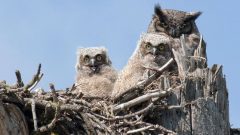
  • Juveniles

    Great Horned Owl

    Juveniles
    • Large, glowing yellow eyes on tawny facial disc
    • Ear tufts not developed yet
    • Camouflage pattern on back
    • Dense barring starting to show on belly
    • © Cameron Rognan, Mojave Desert, Washington, Utah, June 2010
  • Juveniles

    Great Horned Owl

    Juveniles
    • Mostly covered in fluffy down
    • Glowing yellow eyes
    • Tawny brown facial disc
    • © Robinsegg, Yellowstone National Park, Washington, June 2009

Similar Species

  • Adult

    Long-eared Owl

    Adult
    • Superficially similar to Great Horned, but much smaller and skinnier
    • Large ear tufts are closer together on head
    • Bright, rusty orange facial disc
    • Dark mottling on underparts
    • © Cameron Rognan, San Bernadino, California, October 2007
  • Adult

    Long-eared Owl

    Adult
    • Much smaller and more slender than Great-horned Owl
    • Often appears "skinny" and vertically-oriented
    • Proportionally larger ear tufts sit closer together
    • Dark cross-hatches on underparts
    • © Ben Smith, Antelope Valley, California, March 2011
  • Adult

    Barred Owl

    Adult
    • Smaller than Great Horned Owl with rounded head and no ear tufts
    • Large, black eyes
    • Vertical brown streaking on belly
    • Brown and white mottled wings/back
    • © Grant Hickey, Ontario, Canada, November 2010

Similar Species

  • Long-eared Owl slimmer, with proportionately larger ear tufts that are closer together on head.
  • Barred Owl without ear tufts, has streaking, not barring on underparts, and has dark eyes.