

The Pribilof Islands—Galapagos of the North
Text and photos by Bobby Harrison January 15, 2008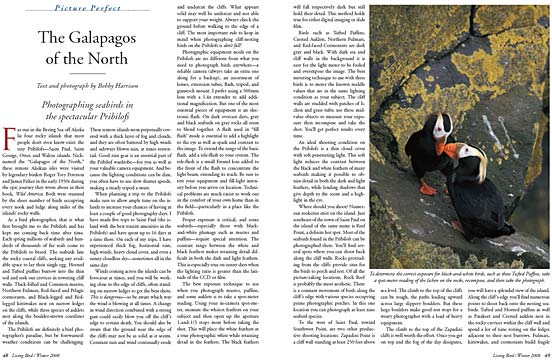
Far out in the Bering Sea off Alaska lie four rocky islands that most people don’t even know exist: the tiny Pribilofs—Saint Paul, Saint George, Otter, and Walrus islands. Nicknamed the “Galapagos of the North,” these remote Alaskan isles were visited by legendary birders Roger Tory Peterson and James Fisher in the early 1950s during the epic journey they wrote about in their book, Wild America. Both were stunned by the sheer number of birds occupying every nook and ledge along miles of the islands’ rocky walls.

As a bird photographer, that is what first brought me to the Pribilofs and has kept me coming back time after time. Each spring millions of seabirds and hundreds of thousands of fur seals come to the Pribilofs to breed. The seabirds line the rocky coastal cliffs, seeking any available space to lay their single egg. Horned and Tufted puffins burrow into the thin soil and seek out crevices in towering cliff walls. Thick-billed and Common murres, Northern Fulmars, Red-faced and Pelagic cormorants, and Black-legged and Red- legged kittiwakes nest on narrow ledges on the cliffs, while three species of auklets nest along the boulder-strewn coastlines of the islands.
The Pribilofs are definitely a bird photographer’s paradise, but be forewarned: weather conditions can be challenging. These remote islands seem perpetually covered with a thick layer of fog and clouds, and they are often battered by high winds and sideways blown rain, at times torrential. Good rain gear is an essential part of the Pribilof wardrobe—for you as well as your valuable camera equipment. And because the lighting conditions can be dim, you often have to use slow shutter speeds, making a steady tripod a must.
When planning a trip to the Pribilofs make sure to allow ample time on the islands to increase your chances of having at least a couple of good photography days. I have made five trips to Saint Paul (the island with the best tourist amenities in the Pribilofs) and have spent up to 16 days at a time there. On each of my trips, I have experienced thick fog, horizontal rain, high winds, heavy cloud cover, and even a sunny cloudless sky—sometimes all in the same day.
Winds coming across the islands can be ferocious at times, and you will be working close to the edge of cliffs, often standing on narrow ledges to get the best shots. This is dangerous—so be aware which way the wind is blowing at all times. A change in wind direction combined with a strong gust could easily blow you off the cliff’s edge to certain death. You should also be aware that the ground near the edge of the cliffs may not be as solid as it seems. Constant rain and wind continually erode and undercut the cliffs. What appears solid may well be undercut and not able to support your weight. Always check the ground before walking to the edge of a cliff. The most important rule to keep in mind when photographing cliff-nesting birds on the Pribilofs is don’t fall!
Photographic equipment needs on the Pribilofs are no different from what you need to photograph birds anywhere—a reliable camera (always take an extra one along for a backup), an assortment of lenses, extension tubes, flash, tripod, and gunstock mount. I prefer using a 500mm lens with a 1.4x extender to add additional magnification. But one of the most essential pieces of equipment is an electronic flash. On dark overcast days, gray and black seabirds on gray rocks all seem to blend together. A flash used in “fill flash” mode is essential to add a highlight to the eye as well as spark and contrast to the image. To extend the range of the basic flash, add a tele-flash to your system. The tele-flash is a small Fresnel lens added to the front of the flash to concentrate the light beam, extending its reach. Be sure to test your equipment and fill-light intensity before you arrive on location. Technical problems are much easier to work out in the comfort of your own home than in the field—particularly in a place like the Pribilofs.
Proper exposure is critical, and some seabirds—especially those with black- and-white plumage such as murres and puffins—require special attention. The contrast range between the white and black feathers makes retaining detail difficult in both the dark and light feathers. This is especially true on sunny days when the lighting ratio is greater than the latitude of the CCD or film.
The best exposure technique to use when you photograph murres, puffins, and some auklets is to take a spot-meter reading. Using your in-camera spot-meter, measure the whitest feathers on your subject and then open up the aperture 1-and-1/3 stops more before taking the shot. This will place the white feathers at a true photographic white while retaining detail in the feathers. The black feathers will fall respectively dark but still hold their detail. This method holds true for either digital imaging or slide film.
Birds such as Tufted Puffins, Crested Auklets, Northern Fulmars, and Red-faced Cormorants are dark gray and black. With dark sea and cliff walls in the background it is easy for the light meter to be fooled and overexpose the image. The best metering technique to use with these birds is to meter the known middle values that are in the same lighting condition as your subject. The cliff walls are studded with patches of lichen and grass tufts; use these mid- value objects to measure your exposure then recompose and take the shot. You’ll get perfect results every time.
An ideal shooting condition on the Pribilofs is a thin cloud cover with soft penetrating light. This soft light reduces the contrast between the black and white feathers of many seabirds making it possible to obtain detail in both the dark and light feathers, while lending shadows that give depth to the scene and a highlight in the eye.
Where should you shoot? Numerous rookeries exist on the island. Just southeast of the town of Saint Paul on the island of the same name is Reef Point, a definite hot spot. Most of the seabirds found in the Pribilofs can be photographed there. You’ll find several spots where you can shoot back along the cliff walls. Rocks protruding from the cliffs provide sites for the birds to perch and rest. Of all the picture-taking locations, Rock Reef is probably the most aesthetic. There is a constant movement of birds along the cliff’s edge with various species occupying prime photographic perches. In this one location you can photograph at least nine seabird species.
To the west of Saint Paul, toward Southwest Point, are two other productive shooting locations. Zapadini Point is a cliff wall standing at least 250 feet above sea level. The climb to the top of the cliffs can be tough, the paths leading upward across large slippery boulders. But these large boulders make good rest stops for a weary photographer with a load of heavy equipment.
The climb to the top of the Zapadini cliffs is well worth the effort. Once you get on top and the fog of the day dissipates, you will have a splendid view of the island. Along the cliff’s edge you’ll find numerous points to shoot back onto the nesting seabirds. Tufted and Horned puffins as well as Parakeet and Crested auklets nest in the rocky crevices within the cliff wall and spend a lot of time resting on the ledges adjacent to their nest burrows. Fulmars, kittiwakes, and cormorants build fragile nests of grasses and seaweeds on the narrow ledges, each providing outstanding photographic opportunities.
These cliffs are also the nesting sites for both species of murres—Thick-billed and Common. The Thick-billed Murre is by far the most numerous species and easily distinguished from the Common Murre by its white-lined bill. Thick-billed Murres may be the most numerous seabird alive. Ornithologists estimate that the worldwide population of Thick-billed Murres numbers 6.8 million breeding pairs. This section of the island looks like Grand Central Station as the murres, puffins, and auklets zoom onto and off the cliff face.
When you are working at any of the rookeries, be very careful not to disturb the birds. Murres lay their one, highly elliptical egg on a very narrow, precipitous ledge. The egg is designed to roll in a very tight circle if disturbed. But loud, boisterous, and invasive activities can spook the birds, causing them to burst off the narrow ledges into flight, sometimes knocking their eggs off the cliff. A pair of murres produces only one egg at a time, and they may not re-lay if the first egg has been destroyed. It is a photographer’s ethical duty always to use caution when photographing wildlife.
West of Zapadini Point is Ridge Wall, a mile-and-a-half long, 100-foot-high cliff that hosts the same species of seabirds found on the Zapadini cliffs. Ridge Wall has an excellent shelf protruding beyond the adjacent cliff wall, allowing great opportunities to shoot back onto nesting birds. Here you will have your best opportunities to photograph Red-legged Kittiwakes. The Pribilof Islands are one of only two places where this species nests in the Bering Sea.
Here you will also find nesting Northern Fulmars, in both light- and dark-phase plumage. Fulmars spend considerable time riding the wind currents along the cliff’s edge, providing excellent opportunities for flight shots. You definitely want to preset your camera exposure before shooting these birds in flight. You will probably be shooting down on the soaring birds with dark ocean water as the background. Metering directly off the dark water usually results in an incorrect meter reading, overexposing the image. For best results, meter a mid-value subject such as lichen on the surrounding rocks or the green grass on the hillside, lock that exposure in the camera, then compose on the subject and shoot.
A 300mm lens is perfect for photographing fulmars as they soar past. Choose a bird flying at some distance away and use the track-focusing feature on your camera to keep the bird in focus. When the bird fills the frame to your satisfaction, begin shooting and don’t stop until it has flown past. As it flies toward you, make a smooth pan as you follow the bird’s flight path. Using a gunstock-mounted lens will make this easier, providing greater mobility while maintaining stability.
Saint Paul has more than just seabirds to photograph. Shorebirds, songbirds, fur seals, and arctic foxes are also present, providing unsurpassed photographic opportunities. Rock Sandpipers are abundant inland throughout the island. Gray-crowned Rosy-Finches, Lapland Longspurs, Snow Buntings, and Winter Wrens are the only passerines regularly found on the island, and they can be photographed in picturesque settings among the abundant variety of northern wildflowers.
The Pribilof Islands provide a unique experience for bird photographers. The islands are remote, visited by few people for any length of time, and despite the horrendous working conditions, the photography is thrilling. There’s nothing quite like scrambling down a wet, grassy slope to stand on a narrow ledge 100 feet above the waves crashing onto a boulder-strewn shore, to photograph spectacular puffins and auklets landing just inches away. That amazing experience can be yours on the Pribilof Islands.

All About Birds
is a free resource
Available for everyone,
funded by donors like you
American Kestrel by Blair Dudeck / Macaulay Library