

• Skip to Content
  • Skip to Main Navigation
  • Skip to Local Navigation
  • Skip to Search
  • Skip to Sitemap
  • Skip to Footer
Help develop a Bird ID tool!

Northwestern Crow

Corvus caurinus ORDER: PASSERIFORMES FAMILY: CORVIDAE

IUCN Conservation Status: Least Concern

  • Related Species
  • Go to:

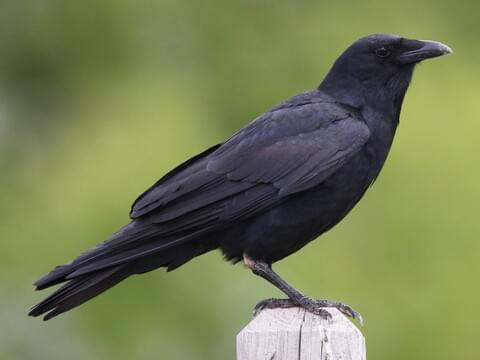
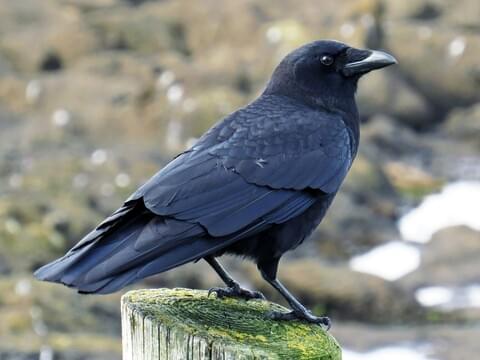
A small crow of the northern Pacific Coast, the Northwestern Crow is becoming quite at home in urban areas as well as along the shore. It is smaller than the American Crow and has a more nasal call, but it is so similar that the two may in fact be the same species.

Get BNA: the definitive resource for North American birds
Donate to Bird Cams

At a GlanceHelp

Measurements
Both Sexes
Wingspan
30.3 in
77 cm
Other Names
  • Le Corneille d'Alaska (French)
  • Cuervo Noroccidental (Spanish)

Cool Facts

  • The Northwestern Crow may be only a subspecies of the American Crow. The two are extremely similar, differing just in size and voice. In the Puget Sound area a number of intermediate crows can be found, and just what species is the common one there is difficult to determine.

Habitat


Open Woodland

Northwestern Crows live near the coast and forage along bays, tidepools, and river deltas. They are also increasingly common in villages, towns, and campgrounds. They also nest on coastal islands, but typically move to the mainland for winter. Northwestern Crows are not often found in deep forest.

Food


Omnivore

Like most crows, Northwestern Crows are omnivores. They eat marine and terrestrial invertebrates, seize fish from tidepools, catch snakes, amphibians, small birds, and small mammals, steal bird eggs and nestlings, and also take fruit, seeds, garbage, and carrion.

Nesting

Nesting Facts
Clutch Size
3–6 eggs
Number of Broods
1 broods
Egg Length
1.6 in
4 cm
Egg Width
1.1–1.1 in
2.8–2.9 cm
Incubation Period
17–20 days
Nestling Period
29–35 days
Egg Description
Blotchy pale green, blue, and gray.
Condition at Hatching
Blind and helpless; minimally covered in down.
Nest Description

The nests of Northwestern Crows are made of branches that range up to a foot in length. The female is the primary nest builder, but the male accompanies her as she works. When they nest on the ground, Northwestern Crows use just a few branches or twigs to make the nest exterior. The nest cup is made of grass, moss, soil, strips of bark, feathers, and leaves. Nests are about a foot across and 9 inches deep, with an inner cup about 6 inches across and 4 inches deep.

Nest Placement

Tree

Northwestern Crow pairs visit several sites before choosing where to nest. Typically this will be in the interior of a tree or shrub, in a blackberry tangle, or on the ground against trunks, in grasses along cliffs, or under tree trunks.

Behavior


Ground Forager

Northwestern Crows often walk along the ground to forage. In flight, they have regular wing beats but sometimes glide or soar on their strong wings. While breeding pairs are monogamous and may stay together for several year, extra-pair copulation is common. In winter, Northwestern Crows of all ages roost together in a complex hierarchical system. Flocks communicate through a variety of signals and sounds, gathering quickly to mob predators. Like some other members of the crow family, they've also been seen "playing," by dropping and catching in midair a small item such as a twig.

Conservation

status via IUCN

Least Concern

Common and increasing.

Credits

  • Verbeek, N. A. M., and R. W. Butler. 1999. Northwestern Crow (Corvus caurinus). In The Birds of North America, No. 407 (A. Poole and F. Gill, eds.). The Birds of North America, Inc., Philadelphia, PA.

Range Map Help

Northwestern Crow Range Map
View dynamic map of eBird sightings
Donate to Bird Cams

You Might Also Like

The Case of the Bizarre Beaks: Story in Living Bird magazine.