
• Skip to Content
  • Skip to Main Navigation
  • Skip to Local Navigation
  • Skip to Search
  • Skip to Sitemap
  • Skip to Footer
Help develop a Bird ID tool!

Eastern Phoebe

Sayornis phoebe ORDER: PASSERIFORMES FAMILY: TYRANNIDAE

IUCN Conservation Status: Least Concern

  • Similar Species
  • Related Species
  • Go to:

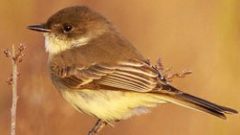
Perhaps the most familiar flycatcher in eastern North America, the Eastern Phoebe nests near people on buildings and bridges. It can be recognized by its emphatic "phee-bee" call and its habit of constantly wagging it tail.

BirdsEye and BirdsEye Lite

Appearance

Flycatchers
Flycatchers
Typical Voice

Adult Description

  • Small songbird.
  • Dark grayish brown back and head.
  • Lighter underparts.
  • No eyering or conspicuous wingbars.
  • Wags tail.

Immature Description

Immature like adult, but with more yellow on belly and noticeable faint wingbars.

Range Map Help

Eastern Phoebe Range Map
View dynamic map of eBird sightings

Field MarksHelp

  • Adult

    Eastern Phoebe

    Adult
    • Stocky and long-tailed with thin, flattened bill
    • Cream-colored breast and belly
    • Dark head and paler gray back and wings
    • © Stephen Ramirez, Clear Creek, Texas, January 2010
  • Juvenile

    Eastern Phoebe

    Juvenile
    • Stocky and long-tailed flycatcher
    • Dark gray above, pale yellow belly
    • Smudgy gray chest
    • © Kelly Colgan Azar, Chester County, Pennsylvania, July 2011
  • Adult

    Eastern Phoebe

    Adult
    • Stocky and long-tailed flycatcher
    • Dark head
    • Pale gray back and wings
    • Faint wing-bars sometimes visible
    • © Roy Brown Photography, Ellijay, Georgia, December 2009
  • Juvenile

    Eastern Phoebe

    Juvenile
    • Larger flycatcher with relatively long tail
    • Juvenile shows more yellow on belly than adult, paler head
    • Smudgy gray breast
    • Gray back and wings
    • © Stephen Pollard, Texas, November 2008
  • Adult

    Eastern Phoebe

    Adult
    • Larger, long-tailed flycatcher
    • Dark head, paler olive-gray on back and wings
    • White to off-white underparts with gray on sides of chest
    • Thin, flattened bill
    • © Kelly Colgan Azar, Chester County, Pennsylvania, March 2011
  • Juvenile

    Eastern Phoebe

    Juvenile
    • Stockier and longer-tailed than other small flycatchers
    • Pale olive-gray back and wings
    • Juvenile shows yellow belly and smudgy gray breast
    • Faint buffy wing bars
    • © Victor Fazio, Wichita Mountains Wildlife Refuge, Oklahoma, May 2008

Similar Species

  • Adult

    Say's Phoebe

    Adult
    • Similar in size/shape to Eastern Phoebe, but with longer tail
    • Distinctive buffy-orange belly and under-tail
    • Dull orange visible under wings when in flight
    • Ashier gray on head and breast
    • © Ganesh Jayaraman, Coyote Valley, California, January 2010
  • Adult

    Black Phoebe

    Adult
    • Similar in size to Eastern Phoebe, but with distinct peaked crown
    • Entirely black head and breast
    • Dark gray back and wings
    • Contrasting snowy-white belly
    • © Lois Manowitz, Tucson, Arizona, December 2009
  • Adult male Slate-colored

    Dark-eyed Junco

    Adult male Slate-colored
    • Stockier than Easter Phoebe
    • Pinkish conical bill
    • Shorter, more rounded wings
    • © Gary Mueller, Rolla, Missouri, February 2007
  • Adult

    Eastern Wood-Pewee

    Adult
    • Smaller and more slender than Eastern Phoebe
    • Peaked crown
    • Broad white wing-bars
    • Dusky olive back and head
    • © Kelly Colgan Azar, Pennsylvania, June 2011
  • Adult

    Willow Flycatcher

    Adult
    • Smaller and more compact than Eastern Phoebe
    • Peak at rear of crown
    • White throat contrasts with brownish olive face and back
    • White wing-bars
    • © Kelly Colgan Azar, Pennsylvania, June 2011
  • Adult

    Least Flycatcher

    Adult
    • Very small and compact
    • White eye-ring and wing-bars
    • Short wings and short, narrow tail
    • Mostly grayish with dull olive on back
    • © Cameron Rognan, Sapsucker Woods, Ithaca, New York, August 2008

Similar Species

  • Black Phoebe is darker with a dark chest.
  • Eastern Wood-Pewee has distinct wingbars and does not wag tail.
  • Empidonax flycatchers have distinct wingbars, usually have distinct eyerings, and do not wag their tails.