
• Skip to Content
  • Skip to Main Navigation
  • Skip to Local Navigation
  • Skip to Search
  • Skip to Sitemap
  • Skip to Footer

American Crow

Corvus brachyrhynchos ORDER: PASSERIFORMES FAMILY: CORVIDAE

IUCN Conservation Status: Least Concern

  • Similar Species
  • Related Species
  • Go to:
American Crow Photo

American Crows are familiar over much of the continent: large, intelligent, all-black birds with hoarse, cawing voices. They are common sights in treetops, fields, and roadsides, and in habitats ranging from open woods and empty beaches to town centers. They usually feed on the ground and eat almost anything – typically earthworms, insects and other small animals, seeds, and fruit but also garbage, carrion, and chicks they rob from nests. Their flight style is unique, a patient, methodical flapping that is rarely broken up with glides. Crows are rarely found alone.

Learn About Celebrate Urban Birds!

Keys to identification Help

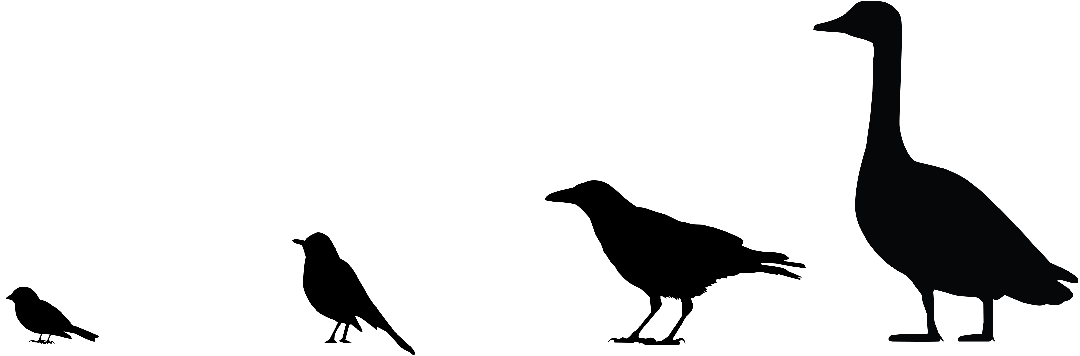
Crows and Jays
Crows and Jays
Typical Voice
  • Size & Shape

    A large, long-legged, thick-necked bird with a heavy, straight bill. In flight, the wings are fairly broad and rounded with the wingtip feathers spread like fingers. The short tail is rounded or squared off at the end.

  • Color Pattern

    American Crows are all black, even the legs and bill. When crows molt, the old feathers can appear brownish or scaly compared to the glossy new feathers.

  • Behavior

    American Crows are very social, sometimes forming flocks in the millions. Inquisitive and sometimes mischievous, crows are good learners and problem-solvers, often raiding garbage cans and picking over discarded food containers. They’re also aggressive and often chase away larger birds including hawks, owls and herons.

  • Habitat

    American Crows are common birds of fields, open woodlands, and forests. They thrive around people, and you’ll often find them in agricultural fields, lawns, parking lots, athletic fields, roadsides, towns, and city garbage dumps.

Range Map Help

American Crow Range Map
View dynamic map of eBird sightings

Field MarksHelp

  • Adult
    Adult
    • Large black bird
    • Thick, sturdy bill
    • Medium-length, square tail
    • Gray bases to neck feathers
    • © Marcus Smith, Los Angeles, California, September 2008
  • Adult mobbing Red-tailed Hawk
    Adult mobbing Red-tailed Hawk
    • All black
    • Broad, rather short, rounded wings
    • Prominent thick "fingers"
    • Evenly rounded tail
    • © Eddie Callaway, Illinois, October 2007
  • Sub-adult calling
    Sub-adult calling
    • Large black bird
    • Medium-length, square tail
    • Throat feathers smooth during calling
    • Some red in mouth, black in full adult
    • © Kevin J. McGowan, Tompkins Co, New York, February 2009
  • Adult in molt
    Adult in molt
    • Scaly pattern over entire back
    • Old feathers brownish, new ones glossy black
    • Tail feathers square-tipped, pointed in immature
    • Eyes dark brown
    • © Kevin J. McGowan, Tompkins Co, New York, July 2008
  • Recent fledgling
    Recent fledgling
    • Shiny black wings but head and body dull blackish
    • Short tail of variable length
    • Silvery black bill
    • Blueish eyes
    • © Kevin J. McGowan, Tompkins Co, New York, May 2007
  • Adult
    Adult
    • Large black bird
    • Thick, sturdy bill
    • Medium-length, square tail
    • Feathers covering nostrils and base of bill
    • © Kevin J. McGowan, Tompkins Co, New York, February 2001
  • Adult
    Adult
    • Thick, sturdy bill
    • Eyes dark brown
    • Sturdy black legs
    • © Kevin J. McGowan, Tompkins Co, New York, February 2009
  • Adult
    Adult
    • Scaly pattern over entire back
    • Sturdy black legs
    • Feathers covering nostrils and base of bill
    • Eyes dark brown
    • © Kevin J. McGowan, Tompkins Co, New York, October 2008
  • Adult
    Adult
    • Medium-length, square tail
    • Thick, sturdy bill
    • Feathers covering nostrils and base of bill
    • Eyes dark brown
    • © Kevin J. McGowan, Tompkins Co, New York, November 2005

Similar Species

Similar Species

The American Crow is nearly identical to both Northwestern and Fish crows. To distinguish Fish Crows, check range maps and listen for the Fish Crow's more nasal calls. Northwestern Crows occur only along the Pacific Northwest coast; they are slightly smaller and best separated by habitat. Common Ravens are larger, longer winged, and heavier beaked than crows. Ravens' tails are tapered at the end, giving them a diamond or wedge shape compared to a crow's shorter, squarer tail.

Regional Differences

Crows in the West are slightly smaller than eastern crows (noticeably so for people with trained eyes). Crows in Florida are small with large feet.

Backyard Tips

Crows don’t regularly visit feeders, but you can attract them to your backyard if you offer a mix of trees, open space, and food. Peanuts left in an open place are a good attractant. Crows are also attracted by compost, garbage, or pet food that the birds can feed on.

Find This Bird

American Crows are fairly common and conspicuous throughout most of the lower 48 states outside the southwestern deserts. You can find American Crows by looking around open areas near patches of woods, or in human modified landscapes like city parks, garbage dumps, campgrounds, manicured lawns, athletic fields, cemeteries and parking lots. Listen for their loud cawing.

Get Involved

You can help scientists learn more about this species by participating in the Celebrate Urban Birds! project.

Report your sightings of crows to eBird. Continentwide data are useful in understanding seasonal changes in the distribution and numbers of crows, as well as impacts from West Nile virus.

You Might Also Like

The crow research page of Dr. Kevin McGowan, a biologist at the Cornell Lab of Ornithology.

Up Close with Crows: An interview with Kevin McGowan

Caller ID for Crows: Sound analysis shows subtle differences in the alarm calls of individual crows

Keeping Company: Crows, sociable and intelligent, are the focus of several studies at the Lab

West Nile Virus Disrupts the Family Lives of Crows: A deadly disease alters crows’ complex societies.

American Crow: Consummate opportunist (Smithsonian Migratory Bird Center)