

Clark’s Nutcrackers Find Whitebark Pine Decline a Tough Nut to Crack
By Taza Schaming
January 15, 2012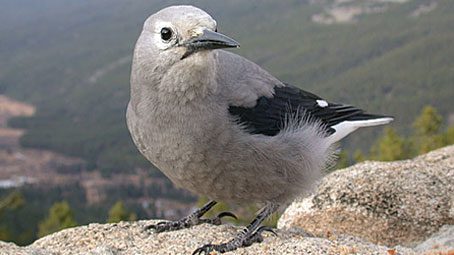

Related Stories

Out West, when you climb up past the treeline, you’re treated to a view of rugged peaks and expansive skies, with just a few wizened pines or firs clinging to the rocky earth. Stop and listen, and you’ll soon hear the loud kraak of a Clark’s Nutcracker. Before long, one of these curious, intelligent birds is likely to land on a nearby whitebark pine, completing a scene that’s thousands of years old.
Without nutcrackers, whitebark pines might never have made it to these mountains. Now, in a reversal, recent declines in whitebark pines might make the birds scarce, too. That’s the problem I’m studying in Wyoming as part of my Ph.D. work at the Cornell Lab of Ornithology.
Clark’s Nutcrackers and whitebark pines have a fascinating relationship: the trees provide rich, fatty seeds (with more calories per pound than chocolate), and the birds plant them—a single bird may bury 98,000 seeds in a year. The food caches help the birds get through the winter, and the leftovers grow into new trees.
Squirrels hoard pine seeds, too, but they store them in big heaps called middens, where few ever germinate. So virtually all whitebark pines grow from seeds nutcrackers planted—in fact, nutcrackers likely carried the ancestors of whitebark pines with them when they came to North America across the Bering land bridge, more than 1.8 million years ago.
But now whitebark pines are dying off, a result of attacks by mountain pine beetles and white pine blister rust. More than a decade ago, the trees started to disappear in Montana and Washington. This summer, the U.S. Fish and Wildlife Service classified whitebark pine as a candidate for listing under the Endangered Species Act.
Though Clark’s Nutcrackers eat many kinds of seeds across their range, whitebark pine is an important food. Sightings in Montana and Washington seem to have declined already. The fear is that this could become a vicious cycle: if fewer whitebark pines lead to fewer nutcrackers, and those birds cache fewer pine seeds, we could wind up with even fewer whitebark pines.
Such a cycle could have a huge impact on the Western landscape. In years when whitebark pinecones are scarce, grizzlies move down into valleys in search of food. This inevitably causes more human-grizzly conflicts. Fewer pines offer less shade for the snowpack, causing spring floods and lower river levels in summer. Those changes in runoff affect cutthroat trout and human drinking water, too.
For my dissertation research, I’m studying Clark’s Nutcrackers in the Greater Yellowstone Ecosystem, where whitebark pines have begun to decline but the birds are still common. Federal agencies are already working hard to restore whitebark pine ecosystems, but to protect nutcrackers we’ll need to learn more about their lives, too.
So I spend most of my year at 9,000 feet, tromping first through snow and then through swarms of mosquitos to track nutcrackers with radio transmitters. I’m learning exactly where these birds forage and breed, where they harvest and cache seeds, and what else they eat other than whitebark pine. By figuring out what these birds need to survive, I’ll be able to make recommendations on ways to conserve them.
It’s hard to imagine hiking through the northern Rockies without these birds or their alpine partners, the emblematic whitebark pines. But I am optimistic that with good, informed management, these wild landscapes will always echo with the calls of nutcrackers.
Originally published in the Winter 2012 issue of BirdScope.

All About Birds
is a free resource
Available for everyone,
funded by donors like you
American Kestrel by Blair Dudeck / Macaulay Library