

Birding Escapes: Catalina State Park, Tucson, Arizona
Text and photograph by Bobby R. Harrison
October 15, 2011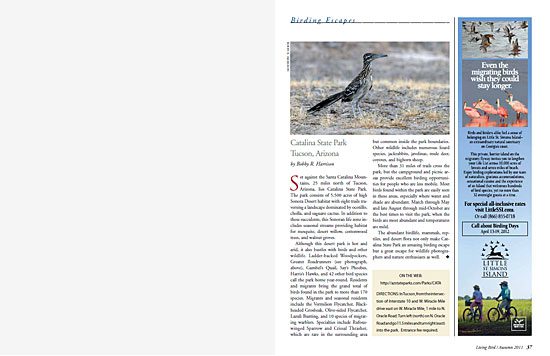

Set against the Santa Catalina Mountains, 25 miles north of Tucson, Arizona, lies Catalina State Park. The park consists of 5,500 acres of high Sonora Desert habitat with eight trails traversing a landscape dominated by ocotillo, cholla, and saguaro cactus. In addition to these succulents, this Sonoran life zone includes seasonal streams providing habitat for mesquite, desert willow, cottonwood trees, and walnut groves.
Although this desert park is hot and arid, it also bustles with birds and other wildlife. Ladder-backed Woodpeckers, Greater Roadrunners (see photograph, above), Gambel’s Quail, Say’s Phoebes, Harris’s Hawks, and 42 other bird species call the park home year-round. Residents and migrants bring the grand total of birds found in the park to more than 170 species. Migrants and seasonal residents include the Vermilion Flycatcher, Black-headed Grosbeak, Olive-sided Flycatcher, Lazuli Bunting, and 10 species of migrating warblers. Specialties include Rufous-winged Sparrow and Crissal Thrasher, which are rare in the surrounding area but common inside the park boundaries. Other wildlife includes numerous lizard species, jackrabbits, javelinas, mule deer, coyotes, and bighorn sheep.
More than 31 miles of trails cross the park, but the campground and picnic areas provide excellent birding opportunities for people who are less mobile. Most birds found within the park are easily seen in these areas, especially where water and shade are abundant. March through May and late August through mid-October are the best times to visit the park, when the birds are most abundant and temperatures are mild.
The abundant birdlife, mammals, reptiles, and desert flora not only make Catalina State Park an amazing birding escape but a great escape for wildlife photographers and nature enthusiasts as well.
Directions:
In Tucson, from the intersection of Interstate 10 and W. Miracle Mile drive east on W. Miracle Mile, 1 mile to N. Oracle Road. Turn left (north) on N. Oracle Road and go 11.5 miles and turn right (east) into the park. Entrance fee required.
On the web:

All About Birds
is a free resource
Available for everyone,
funded by donors like you
American Kestrel by Blair Dudeck / Macaulay Library