

Mementos of a Grouse Long Gone
by Jack Connor
April 15, 2010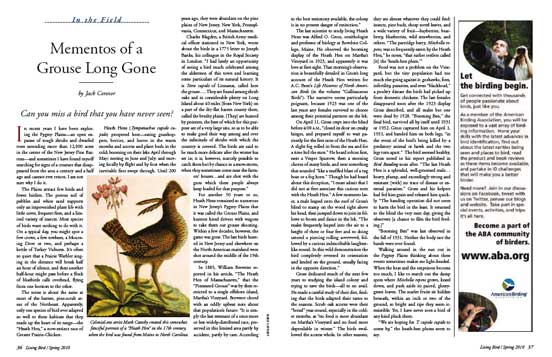


In recent years I have been exploring the Pygmy Plains—an open expanse of tough shrubs and dwarfed trees extending more than 12,000 acres in the center of the New Jersey Pine Barrens— and sometimes I have found myself searching for signs of a creature that disappeared from the area a century and a half ago and cannot ever return. I am not sure why I do it.
The Plains attract few birds and fewer birders. The porous soil of pebbles and white sand supports only an impoverished plant life with little cover, frequent fires, and a limited variety of insects. Most species of birds want nothing to do with it. On a typical day, you might spot a few crows, a few towhees, a Mourning Dove or two, and perhaps a kettle of Turkey Vultures. It’s often so quiet that a Prairie Warbler singing in the distance will break half an hour of silence, and then another half-hour might pass before a flock of bluebirds calls overhead, flying from one horizon to the other.
The scene is about the same at most of the barren, pine-scrub areas of the Northeast. Apparently, only one species of bird ever adapted so well to these habitats that they made up the heart of its range—the “Heath Hen,” a now-extinct race of Greater Prairie-Chicken.
Heath Hens (Tympanachus cupido cupido) prospered here—eating grasshoppers, berries, and leaves in the warm months and acorns and plant buds in the cold; booming on their leks April through May; nesting in June and July; and moving locally by flight and by foot when the inevitable fires swept through. Until 200 years ago, they were abundant on the pine plains of New Jersey, New York, Pennsylvania, Connecticut, and Massachusetts.
Charles Blagden, a British Army medical officer stationed in New York, wrote about the birds in a 1775 letter to Joseph Banks, his colleague in the Royal Society in London: “I had lately an opportunity of seeing a bird much celebrated among the aldermen of this town and learning some particulars of its natural history. It is Tetra cupido of Linnaeus, called here the grouse.… They are found among shrub oaks and in considerable plenty on Long Island about 40 miles [from New York] on a part of the dry flat barren county there, called the brushy plains. [They] are hunted by pointers, the best of which for this purpose are of a very large size, so as to be able to make good their way among and over the infinitude of shrubs with which the country is covered. The birds are said to be much more delicate after the winter has set in; it is, however, scarcely possible to catch them but by chance in a snow-storm, when they sometimes come near the farmers’ houses…and are shot with the guns which these people always keep loaded for that purpose.”
For another 50 years or so, Heath Hens remained so numerous in New Jersey’s Pygmy Plains that it was called the Grouse Plains, and hunters hired drivers with wagons to take them out grouse shooting. Within a few decades, however, the game was gone. The last birds hunted in New Jersey and elsewhere on the North American mainland were shot around the middle of the 19th century.
Related Stories
In 1885, William Brewster reported in his article, “The Heath Hen of Massachusetts,” that the “Pinneated Grouse” was by then restricted to a single offshore island, Martha’s Vineyard. Brewster closed with an oddly upbeat note about that population’s future: “It is simply the last remnant of a once more or less widely-distributed race, preserved in this limited area partly by accident, partly by care. According to the best testimony available, the colony is in no present danger of extinction.”
The last scientist to study living Heath Hens was Alfred O. Gross, ornithologist and professor of biology at Bowdoin College, Maine. He observed the booming display of the Heath Hen on Martha’s Vineyard in 1923, and apparently it was love at first sight. That morning’s observation is beautifully detailed in Gross’s long account of the Heath Hen written for A.C. Bent’s Life Histories of North American Birds (in the volume “Gallinaceous Birds”). The narrative seems particularly poignant, because 1923 was one of the last years any females survived to choose among their potential partners on the lek.
On April 11, Gross crept into the blind before 4:00 A.M., “closed its door on creaky hinges, and prepared myself to wait patiently for the first note of the Heath Hen. A slight fog rolled in from the sea and for a time hid the stars.” He heard robins first, next a Vesper Sparrow, then a morning chorus of many birds, and next something that sounded “like a muffled blast of a tug boat or a fog horn.” Though he had heard about this deception, “I must admit that I did not at first associate this curious note with the Heath Hen.” A few moments later, a male leaped onto the roof of Gross’s blind to stamp on the wood right above his head, then jumped down to join its fellows to boom and dance in the lek. “The males frequently leaped into the air to a height of three or four feet and so doing uttered a piercing rolling wrrrrrrrrb, followed by a curious indescribable laughterlike sound. In this wild demonstration the bird completely reversed its orientation and landed on the ground, usually facing in the opposite direction.”
Gross dedicated much of the next few years to studying the island colony and trying to save the birds—all to no avail. He made a careful study of their diet, finding that the birds adapted their tastes to the seasons. Scrub oak acorns were their “bread” year-round, especially in the colder months, as “no food is more abundant on Martha’s Vineyard and no food more dependable in winter.” The birds swallowed the acorns whole. In other seasons, they ate almost whatever they could find: insects, pine buds, sheep sorrel leaves, and a wide variety of fruit—bayberries, bearberry, blueberries, wild strawberries, and others. “The partridge berry, Mitchella repens, was so frequently eaten by the Heath Hen,” he notes, “that earlier settlers called [it] the ‘heath-hen plum.’”
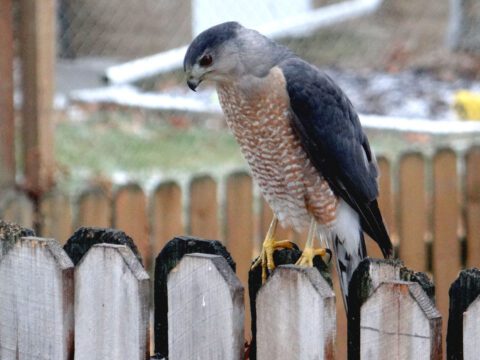
Food was not a problem on the Vineyard, but the tiny population had too much else going against it: goshawks, fires, infertility, parasites, and even “blackhead,” a poultry disease the birds had picked up from domestic chickens. The last females disappeared soon after the 1923 display Gross described, and all males but one were dead by 1928. “Booming Ben,” the final bird, survived all by itself until 1931 or 1932. Gross captured him on April 1, 1931, and banded him on both legs, “in the event of the bird’s being killed by a predatory animal or hawk and the two legs torn apart.” The bird seemed healthy, Gross noted in his report published in Bird Banding soon after. “The last Heath Hen is a splendid, well-groomed male… heavy, plump, and exceedingly strong and resistant [with] no trace of disease or external parasites.” Gross and his helpers had fed him grain and released him quickly. “The banding operation did not seem to harm the bird in the least. It returned to the blind the very next day, giving the observers [a chance to film the bird feeding.]”
“Booming Ben” was last observed in the fall of 1931. Neither the body nor the bands were ever found.
Walking around in the sun out in the Pygmy Plains thinking about these events sometimes makes me light-headed. When the heat and the emptiness become too much, I like to search out the damp spots where Mitchella repens grows, kneel down, and push aside its paired, glossy-green leaves. The scarlet fruits sit hidden beneath, within an inch or two of the ground, so bright and ripe they seem irresistible. Yet, I have never seen a bird of any kind pluck them.
“We are hoping for T. cupido cupido to come by,” the heath-hen plums seem to say.
“Yes, I know,” I reply. “Me too.”

All About Birds
is a free resource
Available for everyone,
funded by donors like you
American Kestrel by Blair Dudeck / Macaulay Library