

How Did the Chicken Cross the Sea?
By Irby Lovette January 15, 2008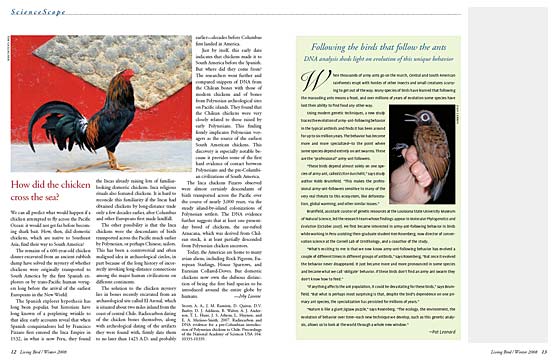
We can all predict what would happen if a chicken attempted to fly across the Pacific Ocean: it would not get far before becoming shark bait. How, then, did domestic chickens, which are native to Southeast Asia, find their way to South America?


The remains of a 600-year-old chicken dinner excavated from an ancient rubbish dump have solved the mystery of whether chickens were originally transported to South America by the first Spanish explorers or by trans-Pacific human voyagers long before the arrival of the earliest Europeans in the New World.
The Spanish explorer hypothesis has long been popular, but historians have long known of a perplexing wrinkle to that idea: early accounts reveal that when Spanish conquistadores led by Francisco Pizzaro first entered the Inca Empire in 1532, in what is now Peru, they found the Incas already raising lots of familiar- looking domestic chickens. Inca religious rituals also featured chickens. It is hard to reconcile this familiarity if the Incas had obtained chickens by long-distance trade only a few decades earlier, after Columbus and other Europeans first made landfall.
The other possibility is that the Inca chickens were the descendants of birds transported across the Pacific much earlier by Polynesian, or perhaps Chinese, sailors. This has been a controversial and often maligned idea in archaeological circles, in part because of the long history of incorrectly invoking long-distance connections among the major human civilizations on different continents.
The solution to the chicken mystery lies in bones recently excavated from an archaeological site called El Arenal, which is situated about two miles inland from the coast of central Chile. Radiocarbon dating of the chicken bones themselves, along with archeological dating of the artifacts they were found with, firmly date them to no later than 1425 A.D. and probably earlier—decades before Columbus first landed in America.
Just by itself, this early date indicates that chickens made it to South America before the Spanish. But where did they come from? The researchers went further and compared snippets of DNA from the Chilean bones with those of modern chickens and of bones from Polynesian archeological sites on Pacific islands. They found that the Chilean chickens were very closely related to those raised by early Polynesians. This finding firmly implicates Polynesian voyagers as the source of the earliest South American chickens. This discovery is especially notable because it provides some of the first hard evidence of contact between Polynesians and the pre-Columbian civilizations of South America.
The Inca chickens Pizarro observed were almost certainly descendants of birds transported across the Pacific over the course of nearly 3,000 years, via the steady island-by-island colonizations of Polynesian settlers. The DNA evidence further suggests that at least one present- day breed of chickens, the ear-tufted Araucana, which was derived from Chilean stock, is at least partially descended from Polynesian chicken ancestors.
Today, the Americas are home to many avian aliens, including Rock Pigeons, European Starlings, House Sparrows, and Eurasian Collared-Doves. But domestic chickens now own the dubious distinction of being the first bird species to be introduced around the entire globe by humans. —Irby Lovette
Storey, A. A., J. M. Ramírez, D. Quiroz, D.V. Burley, D. J. Addison, R. Walter, A. J. Anderson, T. L. Hunt, J. S. Athens, L. Huynen, and E. A. Matisoo-Smith. 2007. Radiocarbon and DNA evidence for a pre-Columbian introduction of Polynesian chickens to Chile. Proceedings of the National Academy of Sciences USA 104: 10335-10339.

All About Birds
is a free resource
Available for everyone,
funded by donors like you
American Kestrel by Blair Dudeck / Macaulay Library