

Steiner Peregrine XP 8×44 Binoculars: Our Review
By Tim Gallagher July 15, 2008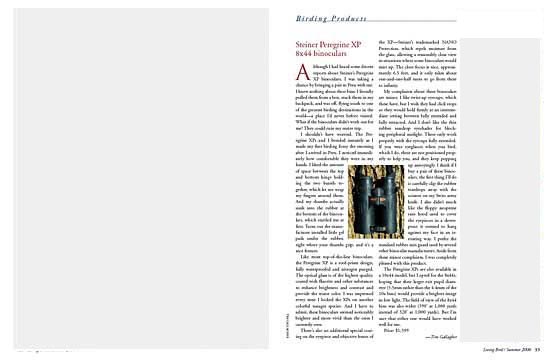


Although I had heard some decent reports about Steiner’s Peregrine XP binoculars, I was taking a chance by bringing a pair to Peru with me. I knew nothing about these bins. I literally pulled them from a box, stuck them in my backpack, and was off, flying south to one of the greatest birding destinations in the world—a place I’d never before visited. What if the binoculars didn’t work out for me? They could ruin my entire trip.
I shouldn’t have worried. The Peregrine XPs and I bonded instantly as I made my first birding foray the morning after I arrived in Peru. I noticed immediately how comfortable they were in my hands. I liked the amount of space between the top and bottom hinge holding the two barrels together, which let me wrap my fingers around them. And my thumbs actually sunk into the rubber at the bottom of the binoculars, which startled me at first. Turns out the manufacturer installed little gel pads under the rubber, right where your thumbs grip, and it’s a nice feature.
Like most top-of-the-line binoculars, the Peregrine XP is a roof-prism design, fully waterproofed and nitrogen purged. The optical glass is of the highest quality, coated with fluorite and other substances to enhance brightness and contrast and provide the truest color. I was impressed every time I locked the XPs on another colorful tanager species. And I have to admit, these binoculars seemed noticeably brighter and more vivid than the ones I currently own.
There’s also an additional special coating on the eyepiece and objective lenses of the XP—Steiner’s trademarked NANO Protection, which repels moisture from the glass, allowing a reasonably clear view in situations where some binoculars would mist up. The close focus is nice, approximately 6.5 feet, and it only takes about one-and-one-half turns to go from there to infinity.
My complaints about these binoculars are minor. I like twist-up eyecups, which these have, but I wish they had click stops so they would hold firmly at an intermediate setting between fully extended and fully retracted. And I don’t like the thin rubber teardrop eyeshades for blocking peripheral sunlight. These only work properly with the eyecups fully extended. If you wear eyeglasses when you bird, which I do, these are not positioned properly to help you, and they keep popping up annoyingly. I think if I buy a pair of these binoculars, the first thing I’ll do is carefully clip the rubber teardrops away with the scissors on my Swiss army knife. I also didn’t much like the floppy neoprene rain hood used to cover the eyepieces in a downpour; it seemed to hang against my face in an irritating way. I prefer the standard rubber rain guard used by several other binocular manufacturers. Aside from these minor complaints, I was completely pleased with this product.
The Peregrine XPs are also available in a 10×44 model, but I opted for the 8x44s, hoping that their larger exit pupil diameter (5.5mm rather than the 4.4mm of the 10x bins) would provide a brighter image in low light. The field of view of the 8×44 bins was also wider (390′ at 1,000 yards instead of 328′ at 1,000 yards). But I’m sure that either one would have worked well for me.
Price: $1,599

All About Birds
is a free resource
Available for everyone,
funded by donors like you
American Kestrel by Blair Dudeck / Macaulay Library