

Lessons From Ted Parker, a Master of Bird Sounds
By Matthew Medler
October 30, 2011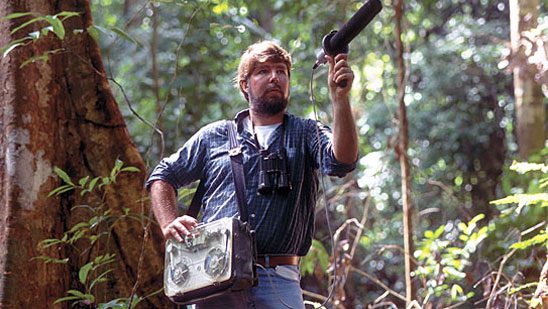

I never met the late Ted Parker, yet I’ve heard his voice thousands of times. It’s a voice that I hope many will come to know as they access his unmatched legacy of more than 10,000 recorded bird sounds that are now available from the Cornell Lab of Ornithology’s Macaulay Library.
Parker was one of the premier ornithologists to have ever worked in Central and South America (the Neotropics). From a 1974 visit to Peru to his tragic death in an airplane accident in Ecuador in 1993, Parker logged nearly 10 years in the field, working in the forests, savannas, deserts, and wetlands of 22 tropical countries. He revolutionized Neotropical ornithology with his focus on bird vocalizations for field identification, survey work, and taxonomic study. Gifted with a boundless memory, Parker knew the vocalizations of nearly all 4,000+ bird species found in the New World. He was also a dedicated “museum person” who logged many hours in Cornell Lab studios to archive his recordings for future generations.
As an archivist at the Cornell Lab of Ornithology’s Macaulay Library, I helped digitize Parker’s vast collection over a period of 11 years. As I worked I paid close attention to his recordings and voice announcements, and it was like taking private lessons from one of the world’s great ornithologists. Parker spoke slowly and affably, yet he was focused, using a minimum of words to note important information in his recordings or to politely “shush” a tour group so he could record an important bird. Now all of Ted Parker’s recordings are online and available to ornithologists and bird enthusiasts everywhere.
Parker’s unparalleled knowledge of bird sounds was due to his tireless efforts with his open-reel Nagra recorder, which he carried nearly everywhere. His archived collection covers more than 1,850 species of birds, mammals, and frogs from Central America, South America, and the Caribbean. Parker also spent time in North America, Africa, and Antarctica, and his entire collection encompasses more than 2,000 species and 280 hours of running time. He added more than 900 new species to the Macaulay Library archive, and even today his analog recordings are the gold standard for countless Neotropical species.
As I worked through reel after 12-minute reel of recordings, I began to think of them as windows into Parker’s ornithological and recording career. I’d work through one species at a time, hearing cuts he recorded years apart. Parker’s recordings from his early visits to South America, such as a Ferruginous Pygmy-Owl (listen) in 1978, were sometimes a bit raw, as he learned what constituted a good recording and worked to refine his technique. These were followed by cuts from what I think of as his peak recording years—the 1980s—when he created countless gems, including a bell-clear clip of a Rufous-fronted Antthrush (listen) (a species he rediscovered) at dawn in the Peruvian rainforest. He was just as diligent at home in the U.S., recording familiar species such as a male Northern Cardinal (listen) singing in Missouri.
His final recordings came from his time as the leader of Conservation International’s Rapid Assessment Program. These recordings were focused and utilitarian—Parker was canvassing remote forest tracts to assess their potential for conservation, and he had little time to spare. But they also contained occasional masterpieces. The Ted Parker recording that stays with me more than any other is of a Scaly-breasted Wren (listen) from his final expedition, to Ecuador’s Cordillera del Cóndor. When I hear this recording, I envision Ted alone on a remote mountainside among mosses, ferns, and bromeliads. Listening as a fellow sound recordist, I see him dealing with several challenges—the sporadic delivery and incredible length of the wren’s song, a windy background, and a rapidly dwindling reel of tape—to record the perfect sequence shortly before he runs out of tape. But mostly, I admire the pure beauty of the wren’s song, as I imagine Ted also did. And finally, I thank him for sharing this recording with me, and now all who care about birds and conservation.
Originally published in the Autumn 2011 issue of BirdScope.

All About Birds
is a free resource
Available for everyone,
funded by donors like you
American Kestrel by Blair Dudeck / Macaulay Library