

Tundra Trek Along Alaska’s Dalton Highway
Text and photos by Gerrit Vyn January 15, 2008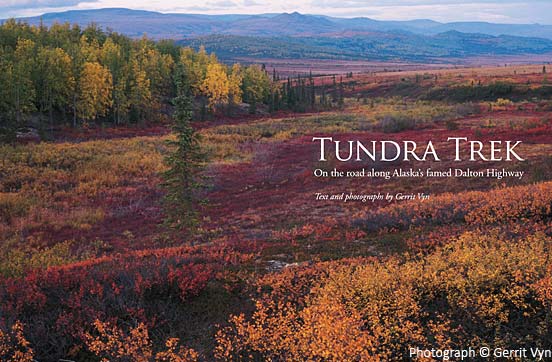



Unlike most people who have experienced the far north, I saw arctic tundra for the first time through the windshield of my pickup truck. I had crossed the Brooks Range on a September night, guided north by my childhood fascination with maps, a road penetrating one of the few remaining vast empty spaces, and a wish to see the birds there. A green aurora borealis danced overhead, flirting with the glowing white ridges and peaks as I crossed the Arctic Divide. Earlier that day, in the boreal forest and foothills to the south, I had seen the most brilliant fall scenery imaginable: ground-hugging plants—dwarf birch, willows, and bearberry—ablaze in blood red; spruces, deep green and blue, mingled with rivers of golden birch and aspen. Above them rose rugged rocky pinnacles dusted with snow, set off by a cobalt blue sky. The wildlife sights were no less spectacular: Northern Hawk Owls hunting from the withered stunted spruces of the taiga, a grizzly bear fording the broad, braided Middle Fork Koyukuk River, and a Northern Goshawk streaking over a small pond where beavers busily prepared for the approaching winter.
Later that night, north of the last mountains, I pulled over and parked on a vast dark plain. In the crisp fall air, filled with excitement and a tinge of lonely fear, I wriggled into my sleeping bag and slept right there, across the seat of my truck.
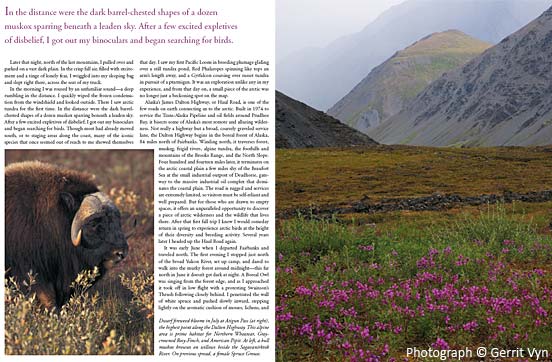
In the morning I was roused by an unfamiliar sound—a deep rumbling in the distance. I quickly wiped the frozen condensation from the windshield and looked outside. There I saw arctic tundra for the first time. In the distance were the dark barrel- chested shapes of a dozen muskox sparring beneath a leaden sky. After a few excited expletives of disbelief, I got out my binoculars and began searching for birds. Though most had already moved south, or to staging areas along the coast, many of the iconic species that once seemed out of reach to me showed themselves that day. I saw my first Pacific Loons in breeding plumage gliding over a still tundra pond, Red Phalaropes spinning like tops an arm’s length away, and a Gyrfalcon coursing over russet tundra in pursuit of a ptarmigan. It was an exploration unlike any in my experience, and from that day on, a small piece of the arctic was no longer just a beckoning spot on the map.
Alaska’s James Dalton Highway, or Haul Road, is one of the few roads on earth connecting us to the arctic. Built in 1974 to service the Trans-Alaska Pipeline and oil fields around Prudhoe Bay, it bisects some of Alaska’s most remote and alluring wilderness. Not really a highway but a broad, coarsely graveled service lane, the Dalton Highway begins in the boreal forest of Alaska, 84 miles north of Fairbanks. Winding north, it traverses forest, muskeg, frigid rivers, alpine tundra, the foothills and mountains of the Brooks Range, and the North Slope. Four hundred and fourteen miles later, it terminates on the arctic coastal plain a few miles shy of the Beaufort Sea at the small industrial outpost of Deadhorse, gateway to the massive industrial oil complex that dominates the coastal plain. The road is rugged and services are extremely limited, so visitors must be self-reliant and well prepared. But for those who are drawn to empty spaces, it offers an unparalleled opportunity to discover a piece of arctic wilderness and the wildlife that lives there. After that first fall trip I knew I would someday return in spring to experience arctic birds at the height of their diversity and breeding activity. Several years later I headed up the Haul Road again.
It was early June when I departed Fairbanks and traveled north. The first evening I stopped just north of the broad Yukon River, set up camp, and dared to walk into the murky forest around midnight—this far north in June it doesn’t get dark at night. A Boreal Owl was singing from the forest edge, and as I approached it took off in low flight with a protesting Swainson’s Thrush following closely behind. I penetrated the wall of white spruce and pushed slowly inward, stepping lightly on the aromatic cushion of mosses, lichens, and Labrador tea beneath my feet. As I moved deeper, I was filled with dread that I might meet a grizzly bear by the dim light of midnight. Overhead a pair of singing Solitary Sandpipers arced in a display flight, appearing from time to time through openings in the trees. Other birds were singing too, and after retreating to my tent from the forest, I realized that the chorus was actually beginning to pick up. The songs of thrushes, sparrows, and an energetic Alder Flycatcher drifted in and out of my sleep.
The dawn and evening choruses at high latitudes are not as we know them in the lower 48. They actually meld into one, beginning at around ten o’clock in the evening with the first thrush songs. The chorus does not end in darkness as it does farther south, but continues to build in twilight until it peaks at about three o’clock in the morning. By eight in the morning, many birds have stopped singing regularly, and at three or four in the afternoon it is difficult to find a bird singing anywhere.
The songs of Swainson’s Thrushes and White-crowned Sparrows are ever-present in the boreal chorus. Songs of Ruby- crowned Kinglets burst energetically from the tops of white spruces, and the songs of Lincoln’s Sparrows ring from the depths of lowland patches of black spruce. Orange-crowned Warblers, Yellow-rumped Warblers, Fox Sparrows, and to the north, Gray- cheeked Thrushes are also prominent and widespread. I quickly realized that to experience the birds fully I would have to adjust my schedule to theirs, being more active by night than by day.
Early the next morning, I took a walk along a roadside burn. Pine Grosbeaks and Olive-sided Flycatchers sang from the tops of snags, the flycatchers sallying out from time to time to dispatch flies with a resounding snap. Bohemian Waxwings buzzed and foraged on ground-growing crowberries preserved by winter’s snow, and a pair of American Three-toed Woodpeckers worked busily to excavate a nest cavity. In the distance a pair of Great Horned Owls hooted in duet, and family groups of Gray Jays moved by, quiet one moment and then startling me with loud piercing calls the next.
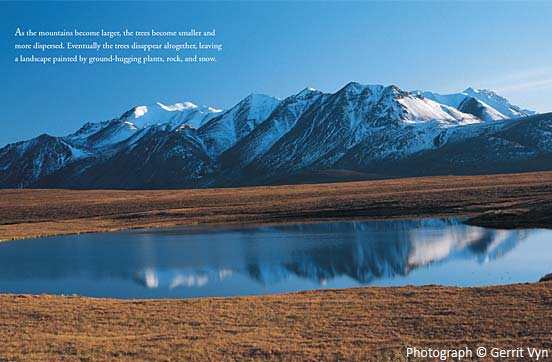
The boreal forest continues on and on. Each rise in the road reveals the immensity of the landscape. On the hillsides, patterns of dark spruce twist and turn amid fresh green aspen and birch, showing the paths of past fires. Farther north, beyond the small settlement of Coldfoot, the rugged foothills of the Brooks Range begin to encroach on the highway. Many of the foothills loom over the Middle Fork Koyukuk River valley and the Dalton Highway it encompasses. As the mountains grow larger, the trees become smaller and more dispersed. Eventually the trees disappear altogether, leaving a landscape painted by ground-hugging plants, rock, and snow. Robert Marshall, a pioneer in wilderness preservation, mapped and explored portions of the Brooks Range more than 70 years ago by foot, boat, and sled. He described it as “endless mountains rising and falling as if the waves of some gigantic ocean had suddenly become frozen in full motion.”
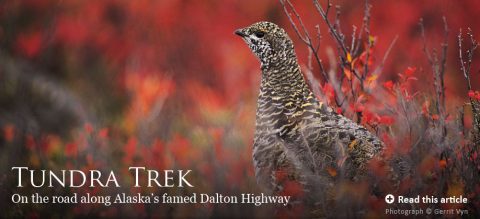
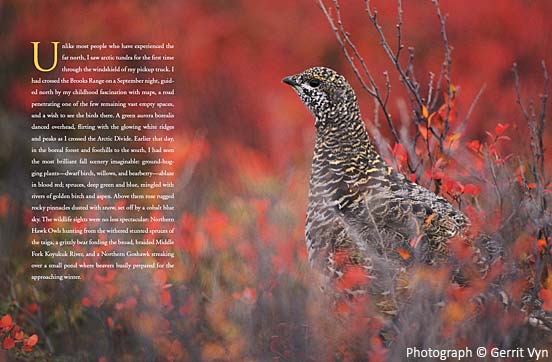
After several days of camping in these foothills, I began the short climb over the mountains toward Atigun Pass. Because the weather had deteriorated and the forests had become dismally quiet, I felt a bit dejected and wasn’t expecting much in the way of birds. It’s remarkable, though, how quickly a day can change. As I traversed the Chandalar Shelf, the weather softened and the russet tundra began to glow beneath a diffuse sun and layered chalky sky. I stopped to soak up the expansive view over the headwaters of the Chandalar River and stepped out of the truck to find five species of sparrow in song: White-crowned, Fox, American Tree, Savannah, and Golden-crowned. From a willow draw above me burst a male Rock Ptarmigan in display flight, muttering its comical undertones. A Short-eared Owl, on mothlike wings, flew past across the tundra, and as I tried to track down a singing Golden-crowned Sparrow, I spotted a grizzly bear sow meandering across the hillside above me.
Energized and excited by the activity around me, I drove on and stopped to explore an icy stream. There I watched a pair of Harlequin Ducks swim against the cold current of the thawing landscape and a pair of Wandering Tattlers probing quietly along the rocky shore. A bit higher, near the pass, several Northern Wheatears and American Pipits sang overhead in flight, and Gray-crowned Rosy-Finches, Snow Buntings, and Baird’s Sandpipers shared a recently thawed hillside with two bachelor Dall sheep chewing their cud.
After crossing Atigun Pass, the road descends through a long glacial valley to the North Slope. The gently rolling landscape is carpeted in dry tussock tundra, interspersed with small lakes, streams, and wide braided rivers. Smith’s Longspurs run among the tussocks singing their simple whistled songs, and American Golden-Plovers perch erect, on constant lookout for predators. The bluffs along the Sagavanirktok River provide some of the few nesting sites beyond the mountains for raptors, such as Gyrfalcons, Peregrine Falcons, Rough-legged Hawks, and Golden Eagles. Large mammals are also more conspicuous in the open treeless terrain. Visitors commonly encounter caribou, muskox, red fox, and grizzly bear, along with the more elusive wolf and wolverine.
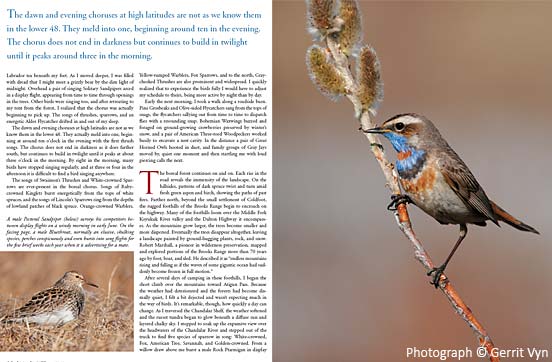
It was with raptors in mind that I hiked along one of the river bluffs of the Sagavanirktok River during my first afternoon beyond the mountains. The sun was shining brightly and Lapland Longspurs, kiting in song flight, provided a melodious backdrop as I hiked. From a ridgeline in the distance I saw several Whimbrels giving their long bubbling songs in gliding flight. Tundra flowers—lousewort, dryas, lupine, and arctic poppy— were beginning to bloom and provided a diversion as I navigated the ankle-biting terrain. Before long I arrived at a loose sodden precipice above the river, where the whistled screams of a pair of Rough-legged Hawks rang out over the din of the river rapids. On broad wings they circled, drifting in and out of view, hidden by the bluffs below. Further on the harsh kak-kak-kak calls of two Peregrine Falcons drew my attention to their nest. In a tuft of grass below I could see their three cinnamon-colored eggs perched precariously beyond the reach of most terrestrial predators. Responding to the birds’ request that I move on, I left the river and wandered up a streamside willow draw in search of something else. There I found my first Bluethroat perched atop a waist-high willow, where it sang its rambling repeated phrases, mimicking many of its tundra neighbors. I recognized the vocalizations of redpolls, wagtails, and longspurs in the Bluethroat’s repertoire, and wondered if some of the unfamiliar sounds might have come from a continent away.
Birds travel incredible distances to breed on the North Slope and arctic coastal plain of Alaska. They converge on the region from wintering grounds spanning the globe. The Bluethroat, weighing less than an ounce, wings its way from wintering grounds in southeast Asia, across the Asian continent and Bering Sea, and then across Alaska, to sing and nest among knee-high willows beside a trickling tundra stream. The Northern Wheatear also flies across Asia, but from wintering grounds shared with elephants and lions in East Africa. Arctic Terns, jaegers, and Sabine’s Gulls lead pelagic lives for nine months of the year in the southern oceans as far away as the Antarctic ice shelf. The Arctic Tern’s journey covers as much as 30,000 miles in a year. Tundra Swans arrive in flocks from coastal wetlands along the eastern seaboard of the United States and quickly disperse with their lifelong mates to their historic nest sites. The Yellow-billed and Pacific loons that nest north of the Brooks Range spend their winters foraging in the coastal waters off Russia and Japan. Baird’s Sandpipers travel through the Americas, following the western mountain cordillera from wintering grounds in South America. American Golden-Plovers and Buff-breasted Sandpipers also migrate from South America, where they winter on the dry pampas of Argentina. Wandering Tattlers and Bar-tailed Godwits migrate from islands in the South Pacific. The godwit makes a nonstop 7,000-mile autumn flight over open ocean from Alaska to New Zealand. When I think how far these birds come—literally from around the world—to nest on the North Slope and arctic coastal plain of Alaska, I can scarcely fathom the gall of some politicians, who call the region a wasteland. The millions of birds that converge there each year provide a stark statement about the value of arctic ecosystems and the abundant resources they provide to the species that return there year after year to rear their young.
The following day I moved north again, to the arctic coastal plain and the town of Deadhorse, terminus of the Dalton Highway. South of town, the bird diversity and abundance swells in the polygonal ponds and wet tundra of the coastal plain. En route, I saw phalaropes, shorebirds, loons, geese, and a lone Snowy Owl sitting on a distant hummock. In town, a pair of King Eiders was joined by a second pair, prompting the two males to engage in a bout of displaying, thrusting their palettes of red, yellow, green, and blue forward, while issuing deep resonating dovelike coos. The females, equally beautiful in their velvety chevron browns, paid little attention to the showy males and foraged quietly in the shallow pond.
After stuffing myself at a buffet in the local hotel, I moved a few miles south of town and set up camp on a broad gravel bar beside the Sagavanirktok River. There, as loose flocks of Pomarine Jaegers winged steadily by, I took a long afternoon nap to prepare for an evening I had been anticipating since my journey began. In the distance I could hear the shorebirds getting warmed up.
If you only experience shorebirds during migration or on their wintering grounds, you scarcely know them. On their breeding grounds, particularly in their nuptial displays, they become something quite different. No longer the birds you see wheeling in flocks or chattering softly on mudflats or shorelines, they become fiercely independent, territorial, and vocal. The males of most species tirelessly perform territorial flight displays, accompanied by complex vocalizations in the early breeding season. They also have diverse repertoires of calls that few species can match.
On the coastal plain around Deadhorse, three species dominate the show—Semipalmated, Stilt, and Pectoral sandpipers. The male Semipalmated Sandpiper’s display consists of long hovering flights, often into the wind, accompanied by constant gurgling, trilling, and sputtering sounds at different pitches, often described as “motorboatlike” sounds. Males often meet each other when displaying in flight, resulting in energetic chases back to earth. Displaying higher above the tundra, male Stilt Sandpipers fly broad circles over their territories issuing an assortment of electronic-sounding vocalizations, one reminiscent of the repeated rising notes of a car alarm. Most impressive of all, male Pectoral Sandpipers inflate a large throat sac and perform low buoyant flights over the tundra, issuing a series of deep hooting notes until their sacs deflate.
When I woke that evening the tundra was alive with sounds. The sun, bright and starlike, hung steadily over the northern horizon. As I dressed for the evening, sliding into my wet, muddy hip waders, the earthy aroma of peat filled my nostrils. An arctic fox, surprised at finding me during its nose-to-the-ground search for bird nests, gave several yips and bolted toward a far-off pingo (a mound of earth-covered ice). I set out over the wet spongy tundra with shorebirds in full display overhead. Semipalmated Sandpipers were constant companions, with males in flight and females often popping up on the tundra to give their laughing calls. Male Pectoral Sandpipers floated by, hooting at eye level, and Red and Red-necked phalaropes spun, chattered, and fluttered around little pools. The background chorus was constant with the mutterings of Rock Ptarmigan, bugling Sandhill Cranes, the winnowing of Wilson’s Snipe high above, chorusing Pacific and Red-throated loons, the yodeling of Long-tailed Ducks, and the honks of restless geese. Long-tailed, Parasitic, and Pomarine jaegers winged by from time to time, on constant lookout for unattended goose nests, lemmings, or unwary shorebirds.
I walked for a long time, absorbed by the abundant life and beauty around me. On the horizon the oil-drilling rigs and the pipeline reminded me of the fragility of this ecosystem. How ironic that the oil being extracted here would contribute to global warming. The melting of the arctic ice might soon put the very ground I was standing on under water.
The radiation of the midnight sun slowly sunk into the nearby sea ice and a brisk fog rolled in, smothering the tundra. With heavy legs I slogged back toward my camp. The aerial display wound down and the birds settled back into the landscape. The tundra can be so quiet. I was reminded of the first time I had been there in autumn and how quiet it was then. It is an easy place to imagine with no birds at all.
The next morning I began the long journey south. As I drove, I couldn’t shake the feeling that I was leaving something I might never see again. In experiencing the arctic at its peak of life, I had come to fully grasp its fragility and the great urgency of preserving it—for its own sake and the well-being of the world’s birds that depend on it. .

All About Birds
is a free resource
Available for everyone,
funded by donors like you
American Kestrel by Blair Dudeck / Macaulay Library