

The Mysterious Squeak of the Anna’s Hummingbird
By Irby Lovette, director of the Fuller Evolutionary Biology Program April 15, 2008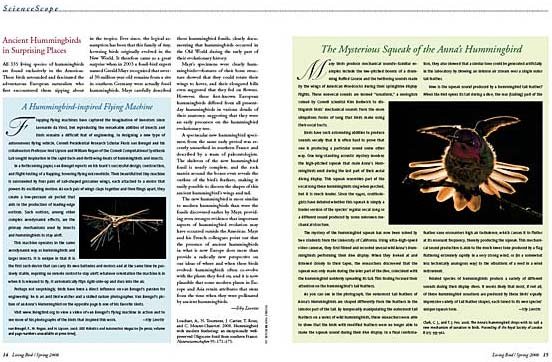
Flapping flying machines have captured the imagination of inventors since Leonardo da Vinci, but reproducing the remarkable abilities of insects and birds remains a difficult feat of engineering. In designing a new type of autonomous flying vehicle, Cornell Presidential Research Scholar Floris van Breugel and his collaborators Professor Hod Lipson and William Regan of the Cornell Computational Synthesis Lab sought inspiration in the rapid back-and-forth wing-beats of hummingbirds and insects.
In a forthcoming paper, van Breugel reports on his team’s successful design, construction, and flight-testing of a flapping, hovering flying microvehicle. Their beautiful but tiny machine is surrounded by four pairs of sail-shaped gossamer wings, each attached to a motor that powers its oscillating motion. As each pair of wings claps together and then flings apart, they create a low-pressure air pocket that aids in the production of leading-edge vortices. Such vortices, among other complex aerodynamic effects, are the primary mechanisms used by insects and hummingbirds to stay aloft.
This machine operates in the same aerodynamic way as hummingbirds and larger insects. It is unique in that it is the first such device that can carry its own batteries and motors and at the same time be passively stable, requiring no remote control to stay aloft: whatever orientation the machine is in when it is released to fly, it automatically flips right-side-up and rises into the air.
Perhaps not surprisingly, birds have been a direct influence on van Breugel’s passion for engineering: he is an avid bird watcher and a skilled nature photographer. Van Breugel’s picture of an Anna’s Hummingbird on the opposite page is one of his favorite shots.
Reference: van Breugel, F., W. Regan, and H. Lipson. 2008. IEEE Robotics and Automation Magazine [in press, volume and page numbers unavailable at press time].

All About Birds
is a free resource
Available for everyone,
funded by donors like you
American Kestrel by Blair Dudeck / Macaulay Library